The Meteorology, Climatology and Geophysics agency (BMKG) predicts that the rainy season in 2022/2023 will come earlier than normal. BMKG has predicted the beginning of the rainy season in Indonesia to occur in September to November 2022. While the peak of the rainy season this year occurred in December 2022 and January 2023.
For some farmers, the arrival of the rainy season brings its own concerns because usually the productivity of chickens in the rainy season is not as good as in summer. During the rainy season, chickens will be more easily stressed, sensitive to the environment and prone to disease. Other problems that often arise in the rainy season such as :
- Decreased quality of drinking water and feed
- Lack of lighting
- Uncomfortable environmental conditions of the cage due to high humidity in the cage
- Puddles that trigger the development of disease vectors such as flies and mosquitoes.
Respiratory diseases of chickens such as Chronic Respiratory Disease (CRD) and complex CRD are closely related to uncertain environmental conditions. The incidence of this disease can appear in any season, both the dry season, the rainy season, and the transition season (change of dry season to rain and vice versa). The following case incident data that we have collected from Medion field personnel for cases Chronic Respiratory Disease (CRD) and complex CRD from January 2021 to July 2022 (Graph 1).
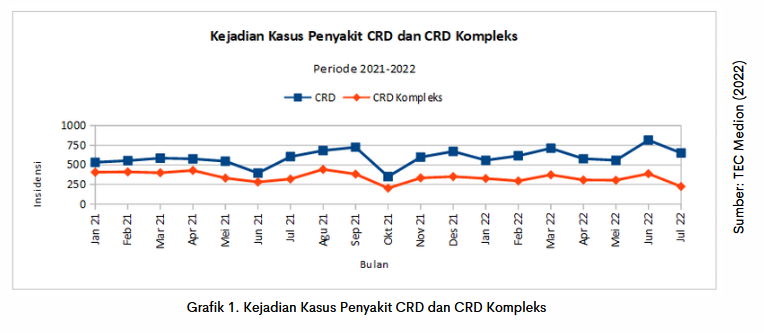
From the graph, the incidence of CRD and complex CRD cases appears to be fluctuating throughout 2021. During the dry season with extreme differences in day and night temperatures, when the heat during the day stings but the night is cold piercing. Meanwhile,in the rainy season the humidity of the environment becomes high which can trigger stress. In addition, environmental conditions like this are ideal for the growth and development of disease seedlings so that chickens become susceptible to infection with CRD and CRD complex diseases.
This can be done by using an open-source API (open house). So, how do we prepare ourselves to face these two diseases in the rainy season of the year? Of course, by getting to know more about CRD and complex CRD diseases, starting from the causes, predisposing factors, prevention, and handling, so that our chicken farms can get through the rainy season this year with optimal productivity.
Causes of CRD and CRD complex diseases
Chronic Respiratory Disease (CRD) is a disease that attacks the respiratory system in chickens that is chronic and can be found in all age groups of chickens. It is called a "chronic" disease because the disease progresses slowly, but the disease process lasts continuously for a long period of time and is difficult to cure.
The cause of CRD disease is the presence of infection from Mycoplasma gallisepticum bacteria-like organisms (bacteria-like organism). M. gallisepticum generally shaped coccoid (the shape is close to round or oval) with a size of 0.25 – 0.5 ⑧m.
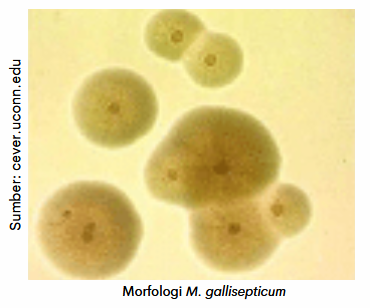
M. gallisepticum sensitive to sunlight and various types of disinfectants, for example Neo Antisep New Formula, Medisep,or Sporades. This microorganism has a distinctive character that does not have a cell wall, it can be resistant to antibiotics penicillin the target of the drug is to damage the cell wall. This mycoorganism can live in feces for 1-3 days at a temperature of 20°C, in the yolk for 18 weeks at a temperature of 37°C or for 6 weeks at a temperature of 20°C.
M. gallisepticum cause serious problems in chickens where the bacteria often work synergistically with other infectious agents such as Escherichia coli. E. Coli infection bacteria are found almost everywhere, especially in dirty places. Disease consequences E. Coli infection often known as colibacillosis. CRD that attacks the respiratory tract, the more open the opportunity for other bacteria such as E. Coli infection to participate in infecting chickens so that a complex CRD occurs. Complex CRD is a combination / complication of disease between CRD and colibacillosis.
Disease incidence and predisposing factors CRD and CRD complex
CRD disease is a disease that is almost always found in every period of keeping chickens, both broilers and layers. This disease is often found during the transition season, the rainy season with high rainfall, long dry season with fluctuating temperature and humidity during the day and night.
Seasonal changes often affect the quality of water in the location of the farm. During the rainy season, increased rainfall will increase the volume of groundwater. During the rainy season, there will be many puddles, where it can be an ideal place for the proliferation of parasites (insects and worms), and pathogenic microorganisms, such as E. Coli infection.
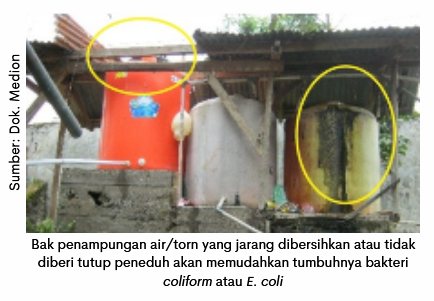
Furthermore, the seeds of the disease that develops will spread very quickly supported by the high movement of water flow during the rainy season. And it is not impossible that well water is polluted. In addition, the water reservoir/torn dirty/rarely cleaned, will be a good place to breed bacteria coliform or E. Coli infection. If the water that chickens drink contains a lot of bacterial contamination E. Coli infection it will increase the incidence of cases colibacillosis.
CRD is immunosuppressive or able to suppress the immune system of chickens. The respiratory tract of chickens is naturally equipped with mechanical defenses in the form of cilia. CRD attacks can cause ciliary damage in the respiratory tract. Even though these cilia are included in one of the primary defense systems that function to prevent the entry of disease seeds. With the malfunctioning of the cilia due to CRD, the seeds of other diseases will easily enter the chicken's body. In the field of CRD cases are often accompanied by complications with the disease colibacillosis, thus becoming a complex CRD.
The incidence of CRD and CRD complex cases will be higher in stressful conditions. Stress factors that can support the occurrence of this disease such as poor maintenance management conditions, high ammonia levels in cages, dusty cage environments, keeping chickens with different ages in one location or multi-age maintenance, temperature fluctuations that occur between day and night, and high humidity in the cage environment.
Transmission of CRD and CRD complex diseases
M. gallisepticum it can be transmitted vertically from an infected mother to chicks, and horizontally, that is, through
aerosols, contamination of feed, water, the environment, other means of livestock production, as well as the activities of workers in cages. The infection is chronic in some birds and can last for days to months. When birds are subjected to stress stress, horizontal transmission can occur quickly through aerosols( respiratory system), after which the infection spreads in one cage or herd/flock.
Once an individual or herd is infected with CRD, these chickens will remain infected for life and act as carriers or reservoirs. Transmission flock to flock occurs easily through direct or indirect contact from the movement of poultry, wild birds, equipment, or workers from flock the infected to flock the vulnerable. Intercellular transmission flock this can be exacerbated in conditions of adjacent cages and chickens kept in one location consist of different ages/multi-age.
Transmission of E. Coli infection it can be vertically from the mother hen to the chicks and usually causes high premature mortality in chicks. Transmission can also be through direct contact with sick chickens can infect sensitive chickens. E. Coli infection also called opportunistic pathogenic bacteria, because the diseases they cause are secondary or as a follow-up to other diseases, for example, CRD. When chickens are exposed to high stress stress, then infected with CRD which is immunosuppressive, bacteria E. Coli infection it will be easier to infect chickens. Transmission E. Coli infection it can also occur by indirect contact, namely transmission through contact between susceptible chickens and materials contaminated by the melting of the body or feces of chickens suffering from colibacillosis.
The process of occurrence of the disease (pathogenesis) CRD and CRD complex
M. gallisepticum enter the body of chickens through the respiratory tract. In addition, the air conditioning system is equipped with a built-in air conditioning system (cilia) and chemistry with mucus (mucus). M. gallisepticum it attaches to epithelial receptors called sialoglycoproteins. Then it sticks and damages the epithelial mucosa while multiplying. The presence of this infection will trigger inflammation and blood flow in the area becomes increased. M. gallisepticum will join the flow of blood and into the air sac, where the air sac is a favorite place M. gallisepticum to live and multiply.
also Mycoplasma has ciliostatic which is a factor that causes Weak activity cilia. In addition, M. gallisepticum is one of several also Mycoplasma which secrete hydrogen peroxide, which can cause oxidative stress on the host cell membrane. Cilia damage and oxidative stress caused by infection M. gallisepticum this is what causes other diseases to easily enter and infect so as to aggravate the disease in chickens. Some diseases that often infect together with these bacteria include collibacilosis, which we later know as complex CRD.
Clinical Symptoms and Pathological Changes
The incubation period of CRD ranges from 6-21 days. Clinical symptoms that appear can vary, from subclinical to difficulty breathing, depending on the severity of the disease. Visible clinical symptoms include mucus discharge from the nose and snoring. Other symptoms that appear are inflammation of the conjunctiva of the eye so that it is swollen and watery.
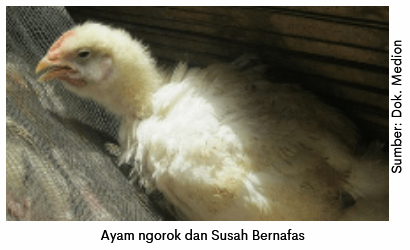
Feed intake down followed by the development of substandard body weight. Chickens can experience growth disorders or decreased egg production in laying hens. The decrease in egg production usually persists at a low level. However, if it is complicated by colibacillosis, then the clinical symptoms that appear in young chickens among chickens look shivering, loss of appetite, weight loss, and increased FCR or ration conversion ratio. Chicks are more often seen in flocks near heaters.
Cases of complex CRD can trigger mortality up to 10-15%, or even up to 20%. While for pure CRD, the death caused is very low, around 5% or none.
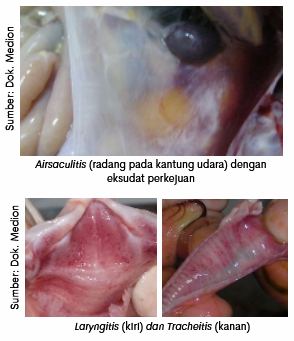
Visible anatomical pathological changes include cavities and sinuses of the slimy nose. If these changes occur over a long time, the mucus will be yellow with a cheesy consistency. The air sacs become cloudy or contain mucus. Turbidity in the air sacs commonly referred to as airsaculitis or inflammation of the air sacs is a typical anatomical pathology changes/pathognomonis in chickens suffering from CRD. In the upper respiratory tract, inflammation of the larynx and inflammation of the trachea can be found.
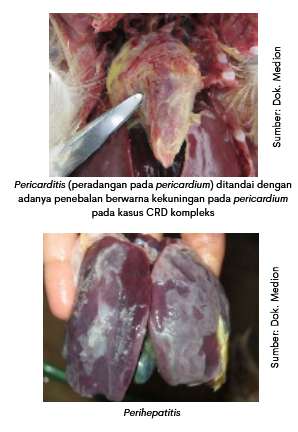
In chickens suffering from complications between CRD and colibacillosis inflammation can be found in pericardium, liver capsuleperihepatitis) and on the airbag. Inflammation of the oviduct is also often found. Other changes that can be found include the mucous membrane of the trachea covered with mucous fluid, swollen and yellowish-red in color.
It is also often found that chickens have diarrhea of green, whitish-yellow color. Chickens that show these clinical symptoms will die in a short time. CRD if it attacks young chickens, symptoms that appear in the form of a weak body, drooping wings and feces colored like soil.
Prevention of CRD
Cases of CRD and complex CRD can appear in any maintenance period. However, such cases can be minimized, such as paying attention to all matters related to maintenance management. In order to prevent CRD and complex CRD diseases, we need to make improvements to the comprehensive maintenance management system, namely by doing the following things:
1. Choosing a good DOC
Improvement can start from choosing a good DOC. Because CRD and colibacillosis can be transmitted vertically, then we need to do the initial selection on the DOC that comes. Repeated events in CRD and CRD complex may have originated from the phase brooding period,.
Farmers who get DOC with poor quality, for example, if farmers get DOC with substandard weight ( broiler and layer). Then it will be more susceptible to respiratory diseases such as CRD and CRD complex.
Another thing that can be done besides choosing a good DOC is to repair the heating system/brooding period, because the indicator of success starts from that phase. Then, suppress the rate of ammonia levels in the cage, with ventilation settings or cage curtain opening and closing systems, including reducing the pile of feces under the floor of the cage (if the cage is a stage).
2. Management litter
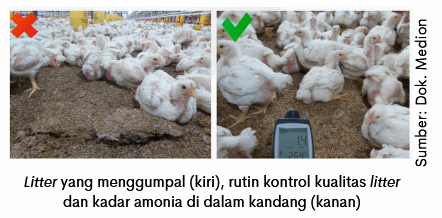
Condition litter it should always be kept in dry conditions, especially during the rainy season. Need to do back and forth management litter to prevent litter wet and lumpy. Litter wet and dirty will trigger the onset of respiratory and digestive tract disorders, because in litter many develop seedlings of the disease.
On the case litter quickly getting wet can potentially increase ammonia levels in the cage. To reduce ammonia levels can be given certain materials that can bind ammonia.One of the products that can bind ammonia is Ammotrol. Products Ammotrol it is a herbal product that is safe to use every day for a long time to bind ammonia without causing side effects and residues. Awarding Ammotrol also relatively easy, simply sprayed into feces or dissolved in drinking water, and can be given together/mixed with vitamins or antibiotics.
Flip-flops litter performed regularly every 3-4 days from the age of 4 days to the age of 17 days. During the rainy season litter it will be easy to get wet and clump. If the amount litter a small lump, then it can be sorted and removed from the cage. However, if the number litter that clumps or wet already a lot, better stack with litter the new to the lumpy does not appear.
3. Good air ventilation
A good air ventilation system will keep the air quality optimal for chickens. Dirty air mixed with ammonia and CO₂ will be wasted out of the cage replaced with oxygen. Setting open and close the curtains, stage floor height and width and distance between cages is very influential on the air ventilation system. On system maintenance open house, during the rainy season curtain management must be considered so that the chicken is not cold and not exposed to rainwater tampias or airflow that is too fast.
4. Keeping chickens healthy
The main thing that is tried to keep chickens healthy is to avoid stress factors. Stress factors include disease agents, uncomfortable environments and poor maintenance practices. Take a multivitamin (Strong n Fit, Vita Stress or Fortevit) and Imustim to increase stamina and endurance of the chicken.
5. Application of biosecurity
As for the application of biosecurity, among others, by improving the management of cages, sanitation and disinfection in the cage environment using Formades or Sporades, carry out cleaning and disinfection of cage equipment (ration places, drinkers, etc.) using Medisep, routinely perform drinking water sanitation using Desinsep to kill E. Coli infection it's in the drinking water.
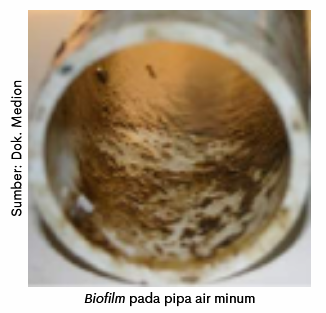
Routine cleaning of drinking water gutters or flushing on drinking water pipes can also be done to prevent the formation of biofilms. Biofilm it is a good medium for bacterial growth E. Coli infection. Biofilm also can be prevented by the use of sound waves by installing the device Harsonic. Harsonic will emit ultrasonic waves so as to shed biofilm that are on the pipe wall and prevent re-formation biofilm. In addition, we can also do water testing in MediLab to test the level of bacterial contamination in chicken drinking water.
Treatment of CRD and complex CRD
Chickens affected by CRD and complex CRD are given antibiotics such as Tinolin, Remisin, or Rofotyl. or injection with Tinolin Injection or Lincomed-LA. In addition to using these antibiotics, efforts to prevent and treat cases of CRD and korisa can use Fithera which is a Medion herbal product.
In addition to giving antibiotics, some actions that must be taken in dealing with CRD cases include:
- Administration of high doses of multivitamins Fortevit at night to cope with stress and increase the stamina of the chicken body.
- In the phase finisher broilers, pay attention to the density of the cage, whether it is really dense or just pseudo-density. When it turns out to be dense, carry out thinning (selection). While pseudo-density occurs when chickens gather in a certain place on one side of the cage to avoid uncomfortable conditions, for example, excessive sunlight or strong wind. For this condition, then set the curtains open and close well.
- If you need to install a plug or blower to help the circulation of air.
- Carry out spraying in cages with disinfectants Antisep or Neo Antisep to eradicate M. gallisepticum and E. Coli infection.
Good maintenance management and strict implementation of cage biosecurity are the key to preventing CRD and complex CRD diseases. Hopefully add insight to all of us and hopefully our farms are protected from CRD and CRD complex diseases in the rainy season this year. Greetings.