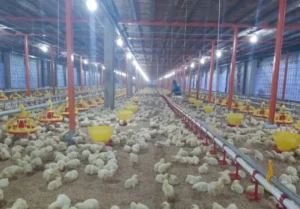
Modern chickens today have a high sensitivity to ambient temperature so that it has an impact on the achievement of growth and development of chickens, one of which is on the maintenance of future pullet. What's more, growth pullet can not be compensated. Each growth of organs and skeletons have their own time and must be achieved in a timely manner so that the readiness of a good egg production period can be achieved. The condition of the farm during the rainy season is certainly different from the dry season. Some of the problems that arise include:
1. Strong winds
The beginning of the rainy season will usually be followed by the appearance of strong winds from an erratic direction. In some areas, especially areas adjacent to mountains, the movement of the wind is very fast and can lead to disaster. High wind speed can make chickens exposed to extreme cold stress (cold stress), damage the chicken coop, even the chicken coop can collapse. Such damage will result in large losses for farmers and automatically disrupt the smooth running of the livestock business.
2. High rainfall
The impact of this high rainfall on chicken farming is as follows:
a. High enclosure air humidity
High air humidity (more than 85%) adversely affects growth and development pullet. The respiratory tract of chickens will be disturbed as a result of the high content of water in the air. In addition, a humid environment is an ideal condition for the growth of bacteria, viruses, parasites and fungi, so chickens become susceptible to disease attacks. High air humidity can also cause the condition of the husk in the postal cage to quickly become damp, wet and lumpy so that the ammonia gas content in the cage becomes high. Coupled with wet husk conditions that can be a medium for the growth of disease seeds. The chicken coop with an open cage system (open houseit is more likely to be affected by high air humidity than chickens kept in a closed cage system (closed house). In a closed cage, there is a stable air movement and the level of air humidity in the cage can be adjusted according to the needs of the chicken.
b. Low water quality
Water is one of the media that can transmit disease seeds to chickens. From data Technical Education and Consultation Medion that the last 3 years( 2017-2019) it is known that 63.82% of the total water samples in the farm contain Coliform above the standard and 44.84% positive contaminated with bacteria Eschericia coli (E. Bra). Water sources that are too shallow, close to the source of piles of feces, near rice fields, rivers/swamps, or septic tank, have a great risk of contamination E. Coli infection. Presence of bacterial contamination E. Coli infection in drinking water given to chickens can cause the risk of chickens easily infected with disease colibacillosis or a small disease cure rate.
c. Low temperature
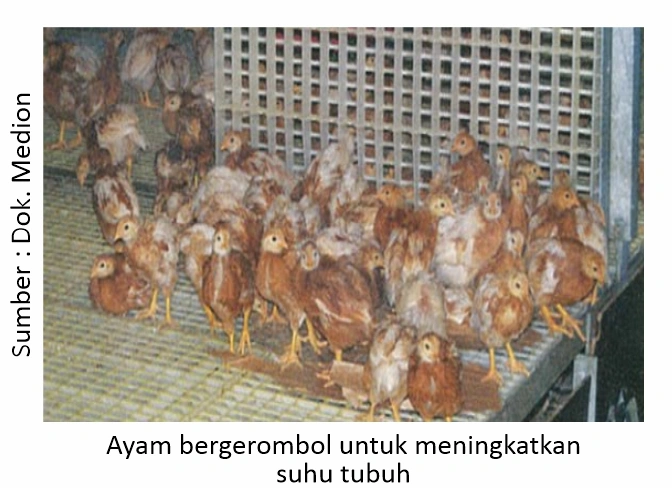
During the rainy season, the ambient temperature is relatively lower (cold air). So that sometimes it is necessary to turn on the heater longer. Accordingly, in the rainy season the costs for heating will be higher. Vulnerable low temperatures can increasingly trigger occur cold stress at the pullet. Cold stress atau hipotermia adalah kondisi turunnya suhu tubuh ayam di bawah normal (40-40,8°C). Kondisi ini lebih sering menyerang ayam muda (umur 0-14 hari). Ayam muda belum mampu mengatur suhu tubuh atau termoregulasi sehingga masih sangat bergantung terhadap suhu lingkungan. Perilaku adanya hipotermia akan semakin terlihat jika suhu lingkungan <15°C. Selain itu, konsumsi pakan dapat meningkat namun konsumsi air minum rendah sehingga tidak tercerna dengan baik. Ayam yang mengalami hipotermia juga dapat mengalami hidrop ascites due to the increased blood flow pressure in the arteries so that the blood plasma seeps and collects in the abdominal cavity. Another impact of this condition is that it can trigger the occurrence of the disease necrotic enteritis (NE) due to an increase in the pH of the cecum for fermentation activity and population Clostridium perfringens increased.
d. Disease-carrying vector populations
The increase in insect populations such as flies and nymauk in the rainy season also needs to be watched out for. The insect can carry the seeds of the disease in the feces to the feed and drinking water. Various disease seeds in the stool can be spread in this way. Especially during the rainy season, worm eggs and bacteria E. Coli infection have better endurance when outside the body of the chicken.
The rainy season must be faced with full preparation. To prevent disease outbreaks and decreased productivity, farmers need to do the following:
- Modified cage management
In this case, the farmer needs to improve the condition of the cage and properly handle feces, husks and insects so that they do not affect the condition of the chickens. In the rainy season, the arrival of strong winds can not be expected in advance and when it appears we can not avoid. For this reason, farmers need to set up a cage curtain opening and closing system with alacrity. If there is rain accompanied by strong winds, the side of the curtain that the wind direction into the cage should be closed immediately so that the rainwater does not tampias. Even if necessary the curtains on each side of the cage are partially closed. Even so, still provide a ventilation gap in the upper cage wall with a width of 20 cm for air exchange. Repair the leaking roof of the cage to avoid rainwater from entering the cage. Widen the roof if it feels like the rainwater is still on the chicken. Perform dredging feces under the cage every 3 days. However, if this activity is difficult to do every 3 days because of heavy rain, farmers need to anticipate the formation of ammonia accumulation in feces by providing ammonia control material to chickens, namely Ammotrol. Also adjust the density of the cage to minimize stress and difficulty pullet reach for food and drink.
- Drinking water sanitation
Drinking water sanitation can use some disinfectant products such as Antisep, Neo Antisep, Desinsep, Medisep, or Zaldes (select one). Some things that must be considered in drinking water sanitation include:
- The dosage of antiseptics used must follow the rules of their use.
- Antisep and Neo Antisep should not be used to dissolve the drug/vitamin because it is a strong oxidizer that could damage the potency of the drug/vitamin. If disinfected drinking water will be used to dissolve drugs/ vitamins, it can use Desinsep, Medisep, or Zaldes. But special drinking water mixed with Desinsep, it needs to be precipitated in advance for at least 8 hours if it will be used to dissolve drugs/vitamins.
- While in the case of vaccination (vaccination through drinking water), do not give water containing antiseptics for 48 hours before and 24 hours after vaccination because the vaccine virus will be damaged or die if it comes into contact with antiseptics. When used for vaccine administration should add water stabilizers such as Medimilk or Netrabil. The purpose of administering these stabilizers is to neutralize the active substances in antiseptics that can reduce the workability of the vaccine.
- In an effort to prevent contamination of disease seeds and so that good microbes in the chicken intestine are not disturbed, the drinking water disinfection program can be done with a 3-2-3 system. This means 3 days of antiseptic Administration, 2 days of regular drinking water and 3 days of antiseptic administration again, and so on intermittently.
To ensure that the water we give to the chicken is qualified clean water and handling of water quality problems can be done properly, you should do the first water sample testing in the laboratory Medion (MediLab). Do periodic testing, especially when there is a change of season or at least once every 1 year.
When flushing will be done using chemicals, while the water pipeline can not be used to drain drinking water to the chicken nipple drinker, so that the chicken is not thirsty, you should prepare a manual drinking place at night when the consumption of chicken drinking is small, or the method flushing this is done when the cage is empty. However, if flushing using water with high pressure or tools Harsonic which utilizes high frequency sound waves to prevent and eliminate biofilms then this does not need to be done.
- Insect control on farms
Control of insect populations can begin with preventing the presence of their breeding grounds. Wet, accumulated feces are especially favorable for flies to lay eggs, and swamps, puddles and bushes are especially favorable for mosquitoes to lay eggs. Therefore, there is a need for good stool cleaning management and if possible the cage is built not adjacent to swamps, ponds, or gardens. Use of products such as Ammotrol it can also be done to help make chicken feces drier and reduce ammonia levels in the cage. If there are many bushes can be cut or cleaned so as not to become a nest of mosquitoes and other pests. The bushes can be replaced with other plants such as Lavender that mosquitoes do not like. However, it should be planted using a pot so that it does not become another pest nest. Insect populations such as flies can also be controlled by the use of Flytox to kill adult flies, and Larvatox to inhibit the development of fly larvae. In addition, the use of light trap it can also be done to control insect populations that are placed in several locations in or around the cage.
- Multivitamins and electrolytes
Extreme weather conditions that make chickens susceptible to stress can be overcome by giving multivitamins and electrolytes to chickens. Vita Stress or Mix Plus LGM which contains mutivitamins and electrolytes that can prevent and overcome stress in chickens when in extreme weather conditions. The hope is that the chicken can still survive and the performance remains optimal.
After taking various precautions or controls above, expected pullet still able to provide the best performance despite the challenging rainy season.