The purpose of ration consumption by chickens is to meet basic living needs, growth, and production. Feed intake or the consumption of optimal rations has an impact on optimal productivity as well. However, cases of a decrease in ration consumption, as a result of which chickens do not want to lay eggs, are still frequent. The following will explain the causes and how to overcome them.
Why Is Chicken Consumption Low?
The factors that cause low consumption of chicken rations include:
- Feed quality
The quality of the ration, both in terms of physical and nutritional content, must be appropriate and meet the needs of chickens. The presence of changes in physical condition (aroma, taste, color, etc.) on the ration usually indicates a change of its nutritional content. Basically, chickens like rations that are fresh, attractive in color, odorless, and not moldy. Chickens also tend to choose rations that are the same size or smaller than their beak size.
The high content of coarse fiber can lead to a decrease in chicken consumption because the palatability (degree of liking) of the ration decreases. In addition, when viewed from the energy content of metabolism (EM). From the results of research, it is known that rations that have a high energy content result in chicken being full quickly so that they tend to reduce consumption.
- Ration management
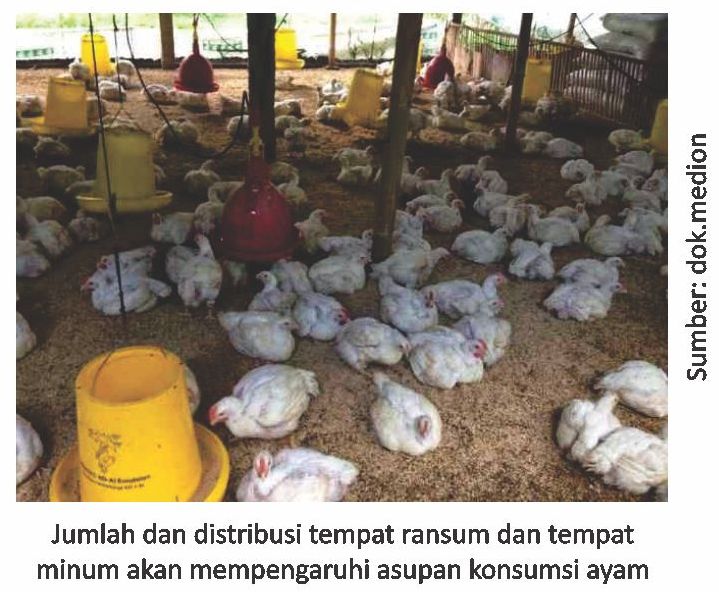
The distribution of the ration must be precise and even. This is related to the ease of chickens to access the ration and the way it is given. The availability of a flat chicken ration also affects the level of uniformity of the chicken. Setting the number, distribution, and height of the chicken ration (TRA) that is not adjusted to age can affect the intake of chicken consumption.
Sudden change of ration and administration lighting (lighting) that is not programmed can cause stress chickens resulting in a decrease in ration consumption. Lighting settings periodically (intermitten lighting) especially at night can reduce stress in broilers and is very useful for stimulating feeding activity. However, especially in laying hens, the provision of this light must be strictly controlled regarding the achievement of chicken performance targets and egg quality during production.
- Uncomfortable environmental conditions
The temperature of the cage is too high can cause chickens to experience heat stress and often do panting (gasps) to stabilize his body heat. Cage temperature should be maintained in comfort zone (comfort zone) i.e. temperature 25-28oC and humidity 60-70%.
During heat stress, the first time chicken response is to focus on increasing the metabolic rate of the body's energy reserves, the rate of movement and intestinal absorption will slow down. As a result, chickens tend to be lazy to eat and will actually drink a lot so that the resulting feces are wetter. The impact of ammonia increases and triggers the spread of disease seeds. Too dense cages will increase competition between chickens for oxygen and food.
- Chicken quality
Since the beginning of maintenance, cache and gizzard chickens should develop well, if disturbed, the consumption of the ration will also decrease and not correspond to the standard.
- Infectious factors (diseases)
The decrease in consumption that occurs due to disease attacks is the most common case found. When a chicken is sick, the immune organs will go the extra mile to produce antibodies. The more antibodies produced, the more energy is needed. As a result, chickens will look lethargic, weak, sleepy and prefer not to eat.
Low Consumption Of Chicken
Nutritional components such as carbohydrates and fats can be utilized to produce energy. Lack of energy intake leads to stunted or slow growth and activity of chickens, as well as low egg and meat production. Thus, the protein whose function was originally for growth and tissue formation will change its function to produce energy. Lack of intake of other nutrients such as vitamins and minerals, also resulted in the amount of production and quality of eggs will decrease in laying hens.
Consumption back to Normal, Optimal production
As for how to restore ration consumption to return to normal include:
- Improving the quality of the ration
Perform ration quality control since the receipt, storage, and mixing process of raw materials and ration storage. With regard to ration quality test, it should be done periodically. In order to facilitate this, Medion has provided ration quality test facility (MediLab) and ration formulation services.
Apply the FIFO system (First In First Out) and make sure that the physical quality of the ration is still good. Rations that are moldy or rancid should not be given because they can cause immunosuppressive effects. Add anti-fungal (mold inhibitor) or toxin (mushroom poison binder) which is widely used in the field, such as Freetox, due to its application it easily and effectively binds fungal toxins.
Set the time of administration and do the ration back and forth as often as possible to prevent the ration from clumping and clumping so as to avoid the growth of mold. In order to meet the availability of essential micro nutrients in it, such as amino acids, vitamins and minerals can add Top Mix, Mix Plus or Mineral Feed Supplement A into the ration.
- Improve maintenance procedures
Provide a chicken ration place (TRA) whose capacity is adjusted to the chicken population. TRA must be quality, made of non-toxic materials, attractive colors, durable/durable, easy to clean and not easily broken. A good TRA height is the tip of the TRA plate as high as the chicken's back so that each chicken has the same access to eat.
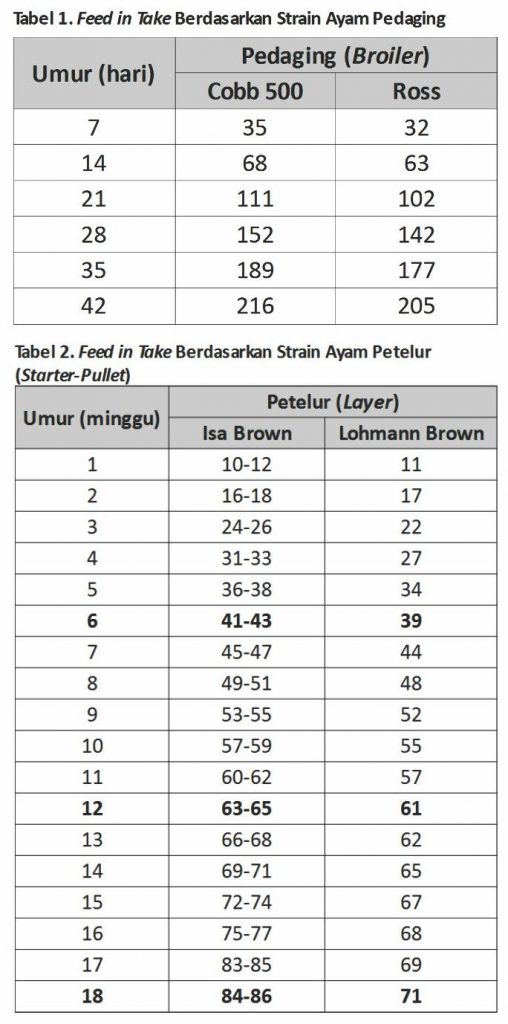
Make sure feed intake (ration intake) is reached at the beginning until the peak of production. Target achievement feed intake can refer to Tables 1 and 2. Make a gradual change in the quality of the ration so that the chickens can adapt to the new quality of the ration. Before and during the change of ration give multivitamins such as Vita Stress to minimize the effects of stress. It is necessary to wash the place of ration and drinking water at least 2 times a week and disinfect it by soaking in a solution Medisep.
Adjust the placement of the lamps for even lighting. For broilers, provide light with an intensity of 30-40 lux for 23-24 hours in the first week. After that, the light intensity can be gradually reduced to 5-10 lux for 16-18 hoursBroiler Signals, 2016). During the production period of laying hens, light is provided for 17 hours with an intensity of 10-15 lux (Lohhman Management Guide, 2015).
- Some things that can be done to stimulate the work function of the digestive tract of chickens, among others, provide rations with coarse fiber content according to the standard, provide the shape and size of the appropriate ration, as well as perform the satisfaction of eating during the day.
- Increase chicken appetiteuse Aminovit and Kumavit it can increase appetite and improve ration conversion so that ration efficiency also increases. Herbal multivitamins Kumavit contains active substances in the extract Curcuma extract which can accelerate the process of metabolism (digestion) of nutrients. The effect is, the stomach empties faster and the chicken's appetite will increase.
- Minimize stress factorsreduce stress-causing factors by creating comfortable environmental conditions for chickens. Pay attention to the temperature and humidity settings, if they are too high, they can provoke mold growth. Open the door and close the door (fan) to help air circulation. Do not forget to adjust the density of the cage so that the chickens are more free to access the ration.
- Handle infectious diseasesto correct the decreased consumption of chicken due to infection, handle it first according to the case of the disease that attacks. As therapy support (for example, a multivitamin )Fortevit, Vita Stress) will greatly help improve the condition of the chicken's body. And then there's the cleaning and the cleaning (Antisep or Medisep) in the cage and its environment to reduce the challenge of disease seedlings.
So, the decline in chicken ration consumption is a critical thing to watch out for so that the cause needs to be evaluated so that we can improve chicken consumption appropriately. Greetings.