
The laying hen farming industry currently faces increasingly complex challenges. Beyond the demands of producing maximum egg quantity and quality, farmers must also maintain production consistency, chicken health, and efficiency amidst dynamic production costs and ever-changing market conditions. Therefore, it's increasingly important to consider all aspects affecting chicken productivity.
During the production period, the chicken layer Egg production faces increasing physiological demands to maintain optimal egg production. Daily egg production requires adequate energy and other nutrients and involves various intensive and interconnected metabolic processes. Under these conditions, the liver plays a crucial role as a metabolic center supporting nutrient supply and egg formation.
Liver Function in Nutrient Metabolism
The liver is one of the largest organs in chickens. Under normal conditions, the liver weighs between 30–50 g, or approximately 1.7–2.3% of total body weight. The liver can be seen after opening the abdominal wall and consists of two lobes: the left and right lobes. The right lobe is larger than the left. The left lobe is clearly divided into medial and lateral portions. In young chickens, immediately after hatching, the liver is yellowish due to the presence of pigments carried along with lipids from the egg yolk (Khamas & Rullant, 2024). In addition to its role in detoxification, nutrient storage, vitamin and mineral metabolism, and bile production, the liver also plays a vital role in the metabolism of nutrients such as carbohydrates, fats, and proteins for the body.
In its role in the body's metabolism, the liver plays a crucial role in regulating nutrient availability according to the body's needs. Several metabolic pathways in the liver, which play a role in maintaining glucose availability, include:
- Glycogenesis, namely the formation of glycogen from glucose for energy storage.
- Glycogenolysis, namely the breakdown of glycogen when the body needs energy.
- Gluconeogenesis, namely the formation of glucose from non-carbohydrate precursors, especially amino acids and glycerol.
- Glycolysis, namely the breakdown of glucose to produce energy.
Meanwhile, in energy metabolism, the liver plays a role in integrating various energy sources, including carbohydrates, fatty acids, and amino acids. When energy needs increase, fatty acids can be oxidized through β-oxidation to produce energy. Conversely, when energy and nutrients are available in excess, they can be stored as fat.
The liver is also a key organ in amino acid and protein metabolism. Amino acids absorbed from the digestive tract are then used to synthesize body proteins, enzymes, hormones, plasma proteins, and various other metabolic molecules (Scanes, 2015).
The Role of the Heart and Challenges in the Production Period
When a chicken enters the production phase, the hormone estrogen stimulates the liver to increase the synthesis of several proteins, particularly vitellogenin, the primary precursor for yolk formation. These proteins are then transported through the blood vessels to the ovaries. In addition to its role in yolk formation, the liver also provides various nutrients necessary to support reproduction through the metabolic processes described above (Walzem, 1996).
One challenge for laying hens is that most of the lipids, or fats, used in yolk formation cannot be transported freely in the blood. Lipids must be packaged with proteins and phospholipids in the form of lipoproteins to be transported through the circulation, a process that occurs in the liver.
Egg production requires the mobilization of large amounts of nutrients. Developing ovarian follicles require high amounts of lipids to form egg yolk. Consequently, during egg production, the liver experiences increased activity for this metabolism. Under normal conditions, this process occurs in a controlled manner, and the lipids produced by the liver are readily distributed to target tissues. However, if there is an imbalance between lipid production and utilization by the tissues, lipids can accumulate in hepatocytes. This is one of the causes of hepatic steatosis.fatty liver in laying hens.
In addition to its role in egg internal quality, the liver also plays an indirect role in eggshell formation. Shell formation occurs in the uterus, while the liver plays a role in metabolism and provides supporting nutrients, including vitamin D, which stimulates calcium absorption for eggshell formation.
Throughout the production phase, the liver faces the challenge of regulating energy use and storage, preventing excessive accumulation of metabolites or lipids, and managing the metabolic needs of other nutrients. peak production, Chickens reach high egg production levels and their metabolic needs increase significantly. During this period, the liver faces significant demands to provide egg-forming precursors, particularly lipids and proteins for follicle development. Maintaining production persistence continues as chickens enter the later stages of production, which can experience changes in feed intake, body fat deposition, antioxidant status, disease challenges, and responses to environmental stress. Therefore, maintaining liver health and performance throughout the production period is crucial.
Liver Disorders in Chickens Layer
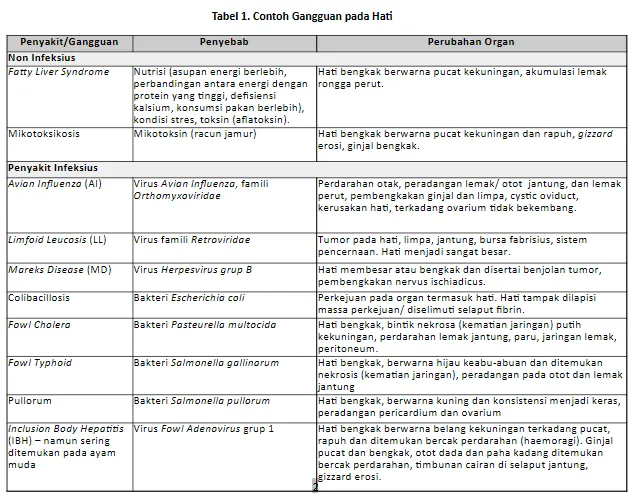
On chicken layer During long-term maintenance, liver disorders can occur due to infectious and non-infectious factors. To diagnose the cause of liver disorders, a thorough examination is necessary, either by necropsy or by gathering information related to feed management and maintenance. Liver damage can be characterized by changes in color, shape, size, and consistency. Examples of observable color changes include the liver becoming pale, mottled, yellow, with white spots, grayish-green, darker (cholangiohepatitis), or the presence of a yellowish-white membrane (perihepatitis). Changes in shape or size will appear enlarged and swollen, with hard nodules or circular ring-like tissue death. Changes in consistency can include the liver becoming brittle or even harder. Some examples of liver disorders are shown in Table 1.
Prevention Of Liver Damage
- Implementation of good ration management, pay attention to nutritional adequacy according to the age and life phase of the chicken, carry out ration quality checks with laboratory tests, giving... toxin like Freetox/Freetox G to prevent mycotoxicosis then good storage such as using a base/pallet, control temperature, humidity and air circulation in the feed warehouse, apply the principle first in first out (FIFO) or first expired first out (FEFO).
- Implementation biosecurity strict measures such as traffic restrictions for both personal, equipment and vehicles, vector control, sanitation of chicken drinking water using Desinsep and spray the cage regularly using disinfectants such as Neo Antisep on the cage contents and Sporades in empty cages, and isolate chickens that show signs of illness.
- Vaccinate chickens using Medivac IBH Emulsion to prevent cases of IBH, Medivac AI to prevent AI disease, vaccination to prevent Fowl Cholera , conducted via Medivac Fowl Cholera.
- Give multivitamins such as Fortevit or immunostimulants such as Imustim to increase the body's resistance.
- Choosing a DOC that is free from infectious diseases, especially diseases that can cause neoplasia (tumors) such as LL and Mareks.
Treatment of disorders and liver damage
Liver damage and dysfunction don't have obvious clinical symptoms, so a diagnosis requires a necropsy and the collection of as much information as possible to confirm the diagnosis and appropriate treatment according to the cause. Generally, treatment for liver damage and disorders in chickens can be carried out as follows:
- Give antibiotics in case of bacterial disease (Colibacillosis, Fowl Typhoid, Fowl Cholera, Pullorum) using Neo Meditril/Tinolin.
- When selecting feed ingredients, if significant fungal contamination is found, do not use those ingredients. If the ration contains only a small amount of contamination, mix it with other uncontaminated feed ingredients or rations. Antifungal agents such as Fungitox.
- Give toxin (Freetox/Freetox G) to treat cases of mycotoxicosis.
- Vitamin supplementation, particularly fat-soluble vitamins (A, D, E, K), amino acids (methionine and phenylalanine), and increasing protein and fat levels in the ration can also reduce losses from mycotoxins. Providing high-dose multivitamins, such as Fortevit could be a solution.
- Add support for the liver to help improve liver function using herbs Heprofit as hepatoprotector.

Ultimately, maintaining liver health is not only about preventing liver disorders and damage, but also ensuring that the liver can perform its metabolic functions optimally during the production period. These efforts need to be carried out comprehensively through the implementation of good husbandry management, balanced ration formulation, appropriate health programs, and the implementation of a comprehensive health program. biosecurity consistent, quality and balanced rations, health management, and biosecurity By maintaining healthy and optimal liver function, the chicken's metabolic balance can be maintained, thus supporting production persistence, egg quality, efficiency, and performance. layer optimal.