Ibu Atika – by email
Permit inquires related to type chicken coop air ventilation closed house. As we know that not a few chicken diseases that spread through the air such as AI, ND with a high mortality rate when it occurs outbreak which ultimately clearly harms the Breeders. How to prevent the spread of disease through the air in cages closed house?
Answer :
Thank you Ms. Atika for the question. Keeping chickens with the system closed house it provides convenience for farmers with the sophistication of equipment. But the system closed house alone will not be enough if not supported by the implementation of management biosecurity and optimal health programs. System usage closed house could potentially occur if the spread of disease seeds sanitation, preparation of cages to biosecurity not done optimally.
As we already know, the application biosecurity become an important element to prevent disease attacks. Three important points in principle biosecurity namely isolation or preventing disease transmission by separation, traffic control that enters the area farm (humans, livestock, equipment, vehicles), as well as sanitation and disinfection.
In principle, the enclosure system closed house it remains mandatory to apply biosecurity in the livestock rearing process includes several components, namely conceptual, structural and operational. Some terms of application biosecurity operational measures for the Prevention of the spread of disease in the cage closed house among them :
- Cleaning, washing cages and spraying disinfectants throughout the farm area. With disinfectants Formades/ Sporades for an empty cage.
- Disinfection of litter / husk before spreading in the cage to eradicate the seeds of the disease if there are attached to the litter. Types of disinfectants that can be used are Formades.
- Also observe hygiene cooling pad, fan, the inside and outside of the curtain cover, the floor of the cage to the ceiling of the roof. Spraying disinfectants on cooling pad at least once every month as with Medisep plays a role in preventing the growth of moss and bacteria. Cooling pad also useful as a filter for air entering the cage and with the addition of disinfectants to the wetting water cooling pad it will be useful to disinfect the air in the cage.
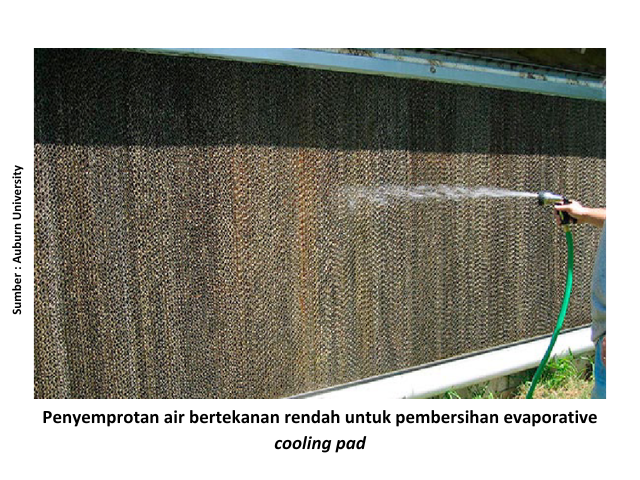
Disinfection of the cage can be carried out taking into account the following points:
- Spray disinfecting can be done when there is still a slight gust of wind
- Spray disinfection is carried out with very soft particles of water or in the form of a mist
- Distance and pressure , it must be consistent so that the disinfectant is evenly distributed over the entire area of the cage
- For the cage closed house, , from the front (inlet) to area (outlet) in order to follow the direction of air flow
- Avoid , disinfect during peak humidity in the cage usually at night or in the morning and when it rains
- Strictly and consistently control restrictions on the traffic of people, goods and vehicles and the implementation of 3 zones
- Routinely clean drinking water tanks, implement automatic water filtration, conduct flushing on drinking water pipes to prevent the formation of biofilm. Action flushing it would be better to help with Bioflush. Biofilm also can be prevented by the use of sound waves by installing the device Harsonic.
- Wash the place of ration regularly, as well as disinfected by soaking in Medisep (15 ml per 10 liters of water), Zaldes (6 ml per 1 liter of water), or Neo Antisep (9 ml per 5 liters of water)
- Provides a means of foot dip and body spray using Antisep or Medisep to the cage officer before entering each cage
- The system control machine should also be cleaned by wiping with a damp cloth. Use an air blower or try to circulate air well in the engine control room.
- Use of special clothes for all officers
- Control the vector of rats and wild birds. As well as combating insects with insecticides. To eradicate the population of flies can use products Larvatox, Flytox and Delatrin.
- Add Ammotrol to bind ammonia odor levels in the cage
- Drinking water sanitationDesinsep) and control of feed storage warehouses
- Control production waste and livestock carcasses
In the implementation of disinfection, to optimize the working power of the disinfectant, it is necessary to pay attention to several things:
- Choose the appropriate type of disinfectant
Choose a disinfectant according to the type of disease seeds to be eradicated. For example, disinfectants from groups ammonium kuartener (Quats) kurang efektif membasmi virus yang tidak beramplop seperti virus Gumboro, Reovirus, dan Avian Encephalomyelitis. The choice of disinfectant should also pay attention to the condition of the chickens. When it will be used for , cages with chickens or drinking water disinfection, choose safe disinfectants such as Desinsep, Antisep, Neo Antisep or Medisep. When the cage is empty all disinfectants can be used. - Proper dosage and mode of administration
Ways of application of disinfectants by means of , it should be done until the surface is wet with disinfectants. The dose of vaccine dilution is in accordance with the product recommendations. - Use quality water
The pH Level of the water should be neutral or 5-8 and the water is not hard (the content of Ca2⁺ and Mg2⁺ ions is small) so that the disinfectant works optimally. PH levels and water hardness can affect the performance of disinfectants, especially the Quats and Iodine groups. - Note the presence of organic matter
Remove organic materials (such as blood, mucus and feces) that stick to the surface of the cage or equipment so that the contact time and disinfectant work are faster and more effective. Aldehyde group disinfectants are not affected by organic materials (eg Formades and Sporades). Proper washing of the cage is necessary for the disinfectant to work optimally.
The use of appropriate disinfectants is one form biosecurity that needs to be applied in a cage to minimize the number of disease seeds in the cage environment. Disinfectants are used to kill or inhibit the growth of pathogenic microorganisms such as bacteria, viruses, and fungi that can cause disease in chickens.