Bapak Indra – By email
1. Inquiry
Are there any remedies to get rid of the smell of chicken droppings? I get complaints from people around my farm because of the pungent smell, even though I regularly dredge chicken manure. Thank you.
2. Answer
Thank you Indra for the question. Strong smelling cages are usually caused by high ammonia levels. Ammonia is a gas produced from the process of breaking down the remains of nitrogen contained in feces or feces by ureolytic bacteria. Ammonia itself in the environment exists in 2 forms, namely the form of bound or dissolved in faecal fluid (NH₄OH) and the gaseous form (NH₃).
The problem of cage odor cannot be underestimated, because it is one of the classic problems in poultry farming. The smell of the cage that lasts for a long time can cause disruption of the health and comfort of chickens and farmers as well as the emergence of pollution/air pollution to the environment around the cage. Ammonia itself production we can not avoid.
High levels of ammonia can be triggered by substandard cage air circulation, overcrowded chicken populations, or poor management of cage bedding (husks) and feces.
To prevent or control ammonia levels in the cage, take the following measures:
A. Temperature and humidity control
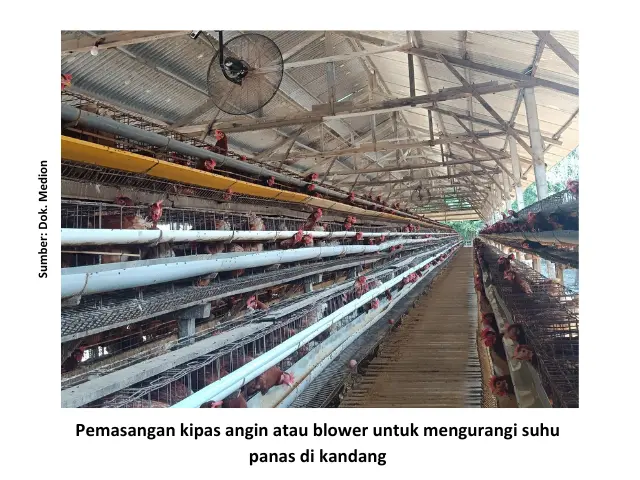
- In humid and hot areas, reducing the air temperature in the cage can be done with the help of blower or a fan. In the installation, blower should pay attention to the direction of wind flow (wind direction should not be back and forth/irregular), the chicken population, wind speed and the volume of the cage room. Also pay attention to the air vents in the cage, arrange them so that the air can circulate smoothly so that the incoming air is not too much and not too little.
- Pay attention to the management of opening and closing the curtains and adjusting the distance between the cages. In addition, the cage closed house can be a solution because it can regulate the temperature and humidity in the cage and remove toxic gases from the cage. Air arrangement of the cage closed house the most important thing is to strive for air quality uniformly and evenly throughout the cage.
B. Set cage density
The ideal chicken density is 15 kg/m2 or equivalent to 6-8 broilers and 12-14 grower laying hens (pullet) per its m2. When the beginning (period brooding period,), widen the cage bulkhead regularly according to the growth of chickens until the entire cage is met.
C. Prevent occurrence wet dropping (wet stool) or diarrhea, because ammonia will quickly form if the condition of the stool is wet and damp.
- Treat cases of gastrointestinal infections (diseases necrotic enteritis, coccidiosis, colibacillosis, etc.) that attack chickens immediately.
- Adjust the need for protein and salt intake in the chicken ration. Too high a salt content in the ration will disrupt the electrolyte balance in the body, resulting in wet chicken feces. High salt levels will also trigger the consumption of more drinking water, causing chickens to easily experience diarrhea. It is possible to check the salt content in the feed in the Medion laboratory to prevent excessive salt levels. This is the case with too high protein levels. This happens because the remaining undigested protein will be converted into uric acid which is high in concentration in the kidneys, causing chickens to drink more. As a result, the stool becomes wet and watery.
D. Stool control management
Pada kandang panggung, tumpukan feses di bawah kolong kandang yang terlalu banyak atau feses basah bisa menimbulkan bau amonia yang mengganggu. Kondisi ini akan lebih parah jika ketinggian kolong kandang tidak sesuai (<1,5 meter) sehingga feses tidak cepat kering. Lakukan manajemen penanganan feses di kolong kandang dengan tepat untuk kandang panggung agar feses ayam tidak lembap dan pembentukan amonia terhambat. Bersihkan feses di bawah kandang minimal seminggu sekali supaya tidak terlalu menumpuk.
In addition, so that the feces become drier can be added materials that can bind water in feces such as the addition of zeolite or lime 1-3%. To combat the presence of flies aggravating the smell of ammonia can be added Larvatox at a dose of 100 g per 1 ton of ration. Larvatox can help improve stool texture and make stool drier.
E. Perform management litter well
- Choose material litter quality (dry, not dusty, able to absorb water optimally) and install it in sufficient quantities (not too thin). Use litter with optimal thickness, which is 8-12 cm for postal cages and 5-8 cm for stage cages. This aims to make the litter become drier and can keep warm temperatures during the period brooding period,.
- For the maintenance system in the postal cage, on litter also can be added lime. The addition of this lime serves to help the absorption of water and air humidity. The addition of lime is also useful to prevent the occurrence of coccidiosis because coccidia (the cause of coccidiosis) is not resistant to heat from Lime.
- On time brooding period,, flip it over litter regularly every 3-4 days, from the age of 4 days to the age of 17 days. This is to avoid litter lumpy from the start. However, if litter there are already clumps but the number is still small, so the clumps can be sorted and removed from the cage. However, if the number litter the lumpy or wet is already a lot, it is better to add litter it's just that the blind can't see. Litter the substitute to be used can be previously sprayed using disinfectants such as Medisep or Zaldes.
- Repair the leaking roof of the cage as soon as possible and avoid hasty work, especially in replacing drinking water. Do not let water spill into litter. Install the drinking place installation correctly so that water leakage does not occur.

F. Minimize ammonia odor
To reduce the smell of ammonia, use materials that are able to bind ammonia, namely Ammotrol. Herbal extracts inside Ammotrol can make the texture of feces become drier, so that the smell of ammonia in the cage is reduced.
Ammotrol will bind ammonia formed from protein metabolic waste into a non-volatile and non-toxic form so that the ammonia smell is reduced, the air in the cage becomes clean, and optimal livestock growth. Ammotrol it can also help increase the permeability of the intestinal wall so that nutrients are easily absorbed by the intestine, which causes the use of rations to be efficient.
FCRFeed Conversion Ratio) decreases, egg production and body weight increases. Awarding Ammotrol relatively easy, simply sprayed into feces or dissolved in drinking water, and can be given together/mixed with vitamins or antibiotics.