Bapak Sofi Hady – by email
Are there any medications or vitamins to prevent and treat limp and paralyzed legs in chickens broiler?
Answer:
Paralysis that occurs in chickens broilerdisease, both at the beginning of maintenance and on the eve of harvest, can be caused by several factors. In general, the causes are divided into 3, among others:
* Genetic factors
Genetic or hereditary factors are the causes of paralysis in chickens that are difficult to prevent or treat.
* Infectious factors
Some examples of infectious diseases that can cause paralysis in broiler chickens include colibacillosis, Mycoplasma synoviae dan staphylococcosis. Some of these diseases are caused by bacterial agents. While those caused by viruses include Avian Encephalomyelitis (AE) and infection Reovirus (Viral arthritis/tenosynovitis and Runting and Stunting Syndrome/Helicopter disease). Paralysis caused by the disease is usually followed by clinical symptoms and other anatomical changes in the body.
* Non-infectious factors
This is mainly due to errors in the management of chicken maintenance such as low content of vitamins C and D, minerals, calcium and phosphorus in the ration consumed and also chicken broiler can be paralyzed due to pinching the walls or floor of the cage. This occurrence is especially more common in chickens raised with a slat floor system.
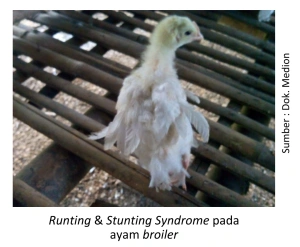
To overcome the case of paralysis in chickens, then we need to know the cause by observing clinical symptoms or changes in the anatomy of the chicken's body. Here are alternative treatments and Prevention :
- Appropriate administration of antibiotics for diseases or paralysis caused by bacterial agents, for example for the disease staphylococcosis, Mycoplasma synoviae and colibacillosis can be assigned Ampicol (0.1 g / kg body weight or 1 g / 2 liters of drinking water for 5 consecutive days) or Tinolin (0.2 ml / kg body weight, given for a maximum of 3 days via intramuscular injection).
- Give multivitamins such as Vita Stress (1 g / 2 liters of drinking water, given for 7-10 consecutive days) or Fortevit (10 g / 60 liters of drinking water) to help increase the endurance of the chicken and accelerate the healing process of the disease. In addition, to prevent paralysis in chickens can also be given Calvita (Prevention: 1 capsule/tail, treatment: 2 capsules/tail).
- Apply concepts biosecurity to minimize disease agents around the cage, for example by spraying the cage, dipping footwear before entering the cage, disinfecting cage equipment and sanitizing drinking water. Examples of disinfectants that can be used are Neo Antisep (9 ml / 5 liters, spray cage: 15 ml/1.5 liters of water) or Medisep (disinfect the cage (spray), place rations and drinking, incubator: 15 ml/10 liters of water, disinfection of shoes/footwear and cars that will enter the cage 15 ml/10 liters of water, prevent disease transmission through drinking water (when there is an outbreak): 3 ml / 10 liters of water).
- Improvement of cage maintenance procedures that can be a trigger factor for paralysis. Changing the base of the cage with a slat shape can minimize injury to the chicken's legs. Slat Alas Cage Medion with a sturdy construction, durable and more hygienic because it is easy to clean from dirt, as well as a simple design that is easy to disassemble and install can be one option to make chicken legs comfortable, safe and avoid contamination of dirt.