Poultry diseases have become one of the serious disorders in poultry farming. The losses obtained are not small if at any time the disease attacks the farm. Various factors can explain why cases of disease are still frequent, including poor maintenance management, extreme temperature fluctuations, plus the impact of El Nino which causes stress, to the lack of optimal vaccination implementation.
Changes in temperature that rise and fall can affect the health condition of chickens with the onset of the risk of disease in the environment of the cage. There are many cases where farmers lack preparation before entering the change of season so that it has an impact on their farms.
Review Of Broiler Diseases In 2023
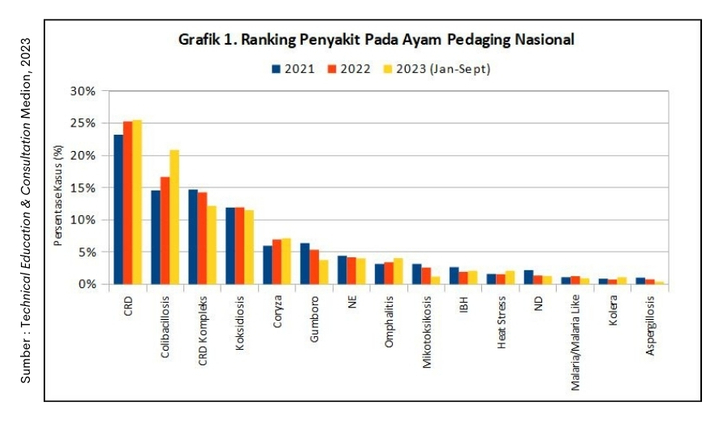
Poultry disease attacks throughout 2023 experienced ups and downs with a pattern almost the same as the previous year's prediction. In broilers (Graph 1), bacterial diseases are still dominated by respiratory diseases CRD, Colibacillosis and complex CRD.
CRD disease is closely related to erratic changes in environmental conditions and can appear in any season. CRD also opens up opportunities for the entry of other infectious agents such as E.bra which causes cases of Colibacillosis. It is seen that the combined case of CRD and Colibacillosis disease or known as complex CRD is quite high at the 3rd rank seen in Graph 1.
The number of Colibacillosis cases has also increased higher than in the previous year (2021-2022). CRD disease, complex CRD, and Colibacillosis are often found during the transition season, the rainy season with high rainfall, and the long dry season with fluctuating temperature and humidity during the day and night. These weather changes trigger the chicken's immune system to decline.
As for viral diseases in broilers, obtained data on diseases that still occur such as Gumboro, IBH and ND. In addition, parasitic diseases such as coccidiosis are still common. Case heat stress there was also an increase in broilers compared to the previous year. The phenomenon of the dry season is long enough to make the case heat stress much happens in the period finisher.
Review Of Diseases Of Laying Hens In 2023
Slightly different from broilers, the case in laying hens will be highlighted from two maintenance periods, namely before the production period (graph 2) and during the production period (graph 3). In laying hens before entering the production period dominated CRD, Coryza and coccidiosis.
Bacterial diseases that affect breathing such as CRD and Coryza have increased from the previous year. Where the predisposition to the disease is due to mismanagement, for example, too dense cages, high ammonia levels, temperature and humidity when brooding period, not as needed, etc.
In the same way, the presence of bovine tuberculosis (bovine tuberculosis), bovine tuberculosis (bovine tuberculosisFowl Pox) and AI dominates as a viral disease. In laying hens, the case of Gumboro is related to the development of immune organs that begin to actively work at 3-6 weeks. So it is necessary to increase vigilance in the maintenance phase pullet.
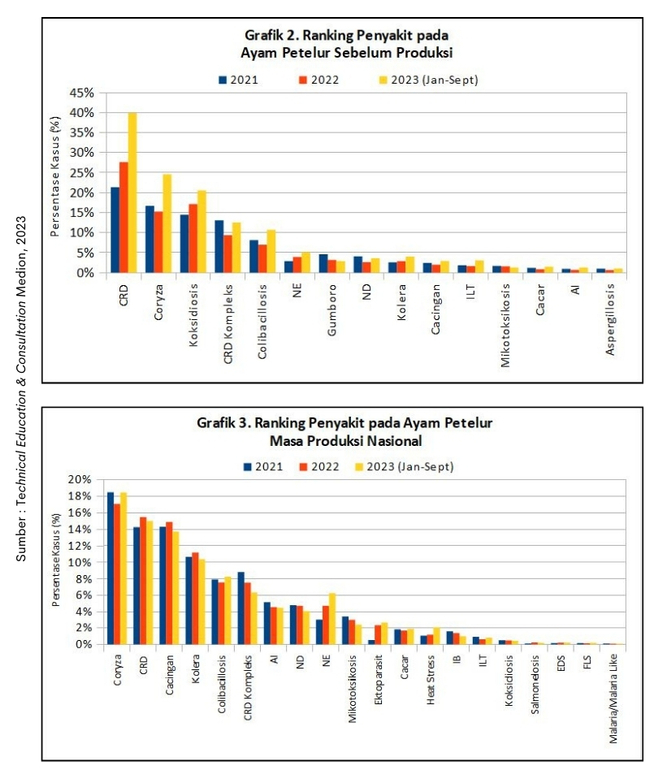
Coryza bacterial disease is still the highest disease ranking in laying hens production, followed by CRD disease (graph 3). In addition, there were also cases of disease Fowl Cholera which increases and ranks 4th out of all cases of the disease. Other bacterial diseases that have increased from the previous year are Necrotic Enteritis.
The most common cause of heart failure is a heart attack, followed by a heart attack (Fowl Pox), IB and ILT. Heat stress disorders increased from the previous year.
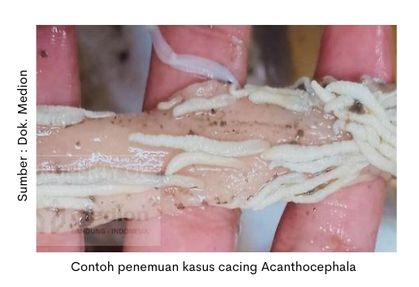
Cases of worms are still common and ranked in the top 3 during the production period. This parasitic disease of worms is also quite troubling for laying hen farms. This disease can reduce the health of chickens to a decrease in egg production. In addition to several types of worms that often attack laying hens, poultry has recently experienced cases of helminthiasis that look different, namely the case of Acanthocephala.
El Nino dan Heat Stress
The El Nino phenomenon in Indonesia causes a long dry season and hot weather conditions. It is known that the daily temperature during the maintenance of chickens in cages can exceed 35°C. This affects the situation in the poultry industry where chickens become uncomfortable and experience stress.
Chickens today are increasingly sensitive to environmental changes and are easily stressed due to extreme weather conditions, including the El Nino phenomenon in the last year. The impact of stress on chickens should not be underestimated.
A rise in temperature can result in heat stress which can reduce productivity, prone to illness, resulting in nutritional deficiencies to the worst sudden death.
Heat stress will result in a breakdown of the electrolyte balance of cells that is accompanied by effects on almost all body systems including digestive tract disorders syndrome. The negative effects that arise are non-specific diarrhea or the resulting stool is thinner because the chicken will drink more which makes the stool consistency wetter.
Cekrek disease in various weather conditions
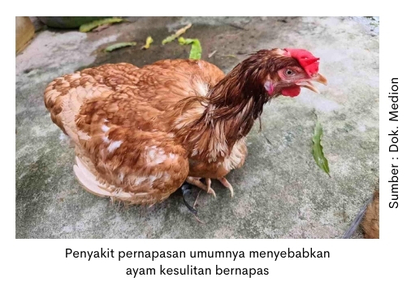
CRD and CRD complex diseases dominate in the highest 3 disease rankings because cases often occur repeatedly in the same farm. Chicken respiratory diseases such as CRD and complex CRD are closely related to uncertain environmental conditions.
The incidence of this disease can appear in any season, both the dry season, the rainy season, and the transition season (change of dry season to rain and vice versa). These bacterial diseases can be triggered by poor air circulation conditions in cages, ammonia levels that are too high, too high cage density and maintenance with various ages in one farm location.
In order to prevent CRD and complex CRD, it is necessary to implement a comprehensive maintenance management system such as handling litter cage, cage density settings, cage ventilation settings and biosecurity strictly.
The emergence of the latest AI Clade
Based on team monitoring Technical Education and Consultation (TEC) and Surveillance Analyst Medion against disease AI virus character changes, obtained reports of the emergence of AI subtype H5N1 clade 2.3.4.4 b which has never been found in Indonesia before.
As reported on the official WOAH page, the AI outbreak subtype H5N1 clade 2.3.4.4 b this has caused high mortality cases on duck farms in South Kalimantan province in November 2022.
Teams surveillance Medion also found AI clade 2.3.4.4 b from duck farms in Central Java. The impact is very high (morbidity rates reach the range of 70-90% and mortality 40-60% within 1 Week) causes this disease should always be aware of.
Swollen Head Syndrome that spread back
In the field, respiratory diseases that are quite unsettling are Swollen Head Syndrome (SHS). The number of cases of SHS disease is seen to be increasing although the ranking of diseases is still low when compared to other diseases. In 2023, Medion discovers a suspect case similar to coryza. But after the administration of antibiotics does not also give healing results.
Then Medion confirmed the diagnosis with laboratory tests and found positive results of SHS disease. Some cases of SHS found Medion team further traced with PCR test. In the past, the production process has been dominated by the production of raw materials (Animal & Agriculture Laboratory Testing- Medion, 2023).
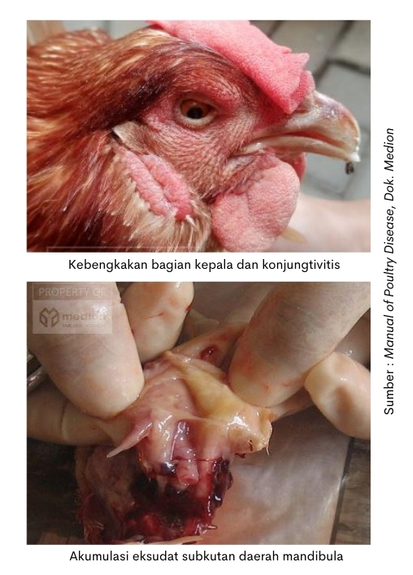
SHS is caused by avian pneumovirus (APV), which includes family Pneumoviridae. This Virus is amplified, not segmented and is a virus single-stranded RNA that has a high sensitivity to various groups of disinfectants. Typical symptoms that appear in this disease are conjunctivitis, watery eyes, swelling of the infraorbital sinus, swelling of the mandible (around the lower jaw) and head, sneezing, fine snoring, as well as dyspnoe (difficulty breathing).
During carcass surgery, changes appear such as edema and inflammation in the infraorbital sinuses, larynx, trachea, and subcutaneous areas in the head and Mandibular region. In the event that has been going on chronically and there is a secondary infection E.bra, the accumulation of mucus over time will turn into a period of perspiration.
Conditions that can trigger the occurrence of this disease are the same as other respiratory diseases, namely poor maintenance management, poor air circulation in the cage and high levels of ammonia in the cage. The incidence of this disease can also increase due to vaccination programs on farms that have not been comprehensive.
Cholera Cases Begin To Lurk
Cholera or known green poop is caused by bacteria Pasteurella multocida which can survive in soil or decaying materials for several months but are easily damaged or killed by various disinfectants and direct sunlight.
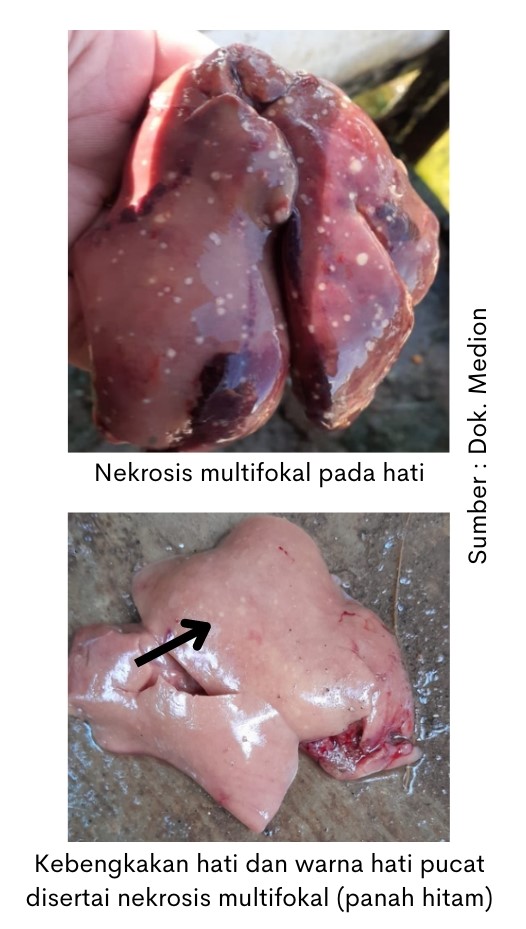
Some of the clinical symptoms that occur in chickens infected with cholera are bluish Combs, decreased appetite, lethargy, feather loss, diarrhea which is initially yellowish watery, then will turn greenish with mucus (mucus), sometimes found torticollis, increased respiratory rate, facial area, Combs and wattles swell containing material in the form of cheese and compact. After the chicken is dissected, inflammation of the trachea, bleeding in the form of ptechiae (points) or echymosis (spread/extends) on the heart, lungs, heart fat and abdominal fat. The enlarged liver is striped in color and there are necrotic white spots.
The incidence of cholera can be triggered by several factors, such as stressful conditions due to extreme weather, immunosuppressive disease attacks, and dirty and damp cage conditions. Chickens that have been infected with this disease and then recovered can act as carrier or carrier.
Prediction Of Poultry Diseases In 2024
In general, the likelihood that some diseases will appear in 2024 is relatively the same as in previous years. Respiratory and digestive diseases, both caused by bacteria and viruses in laying hens and broilers, will still dominate. This is related to the fluctuating weather conditions and the farm environment whose air quality is declining.
- Diseases that affect poultry that have an impact on egg production can cause high losses for farmers. The diseases in question such as ND, AI, IB and also the emerging ones such as SHS.
- The development of the virus needs to be constantly monitored, especially ND, AI and Gumboro, which are easily subject to change. And monitoring of bacteria H. Paragalinarum the cause of Coryza disease where cases of the disease increase in 2023, especially in laying hens. Then Gumboro usually attacks during the transition season or transition conditions.
- During the rainy season and transition, coccidiosis and colibacillosis are likely to continue to appear. Issues to be considered such as management litter with a high degree of humidity resulting in the growth of oocysts Eimeria the causes of coccidiosis are increasing.
- Alert the increase in cases of mycotoxicosis and fungi, especially in feed and drinking places.
Steps To Anticipate Poultry Diseases
Strategic steps to take on farms for 2024:
- Support with good chicken rearing management. Especially pay attention to the quality of seeds DOC, pay attention to management brooding period,, smooth ventilation, cage density regulation, and management litter. Litter it is often re-used and litter wet or lumpy ones need to be sorted out and removed from the cage. Wherever possible maintenance is done system all in all out. Give Grow Chicks early in the maintenance to accelerate the absorption of egg yolk and help the development of organs DOC.
- The application of closed house system cages will be more effective because it can help minimize the influence of environmental conditions that are currently very volatile and trigger the spread of disease.
- Vaccinate appropriately (accuracy in determining the vaccination schedule, vaccine quality, appropriate vaccination management and the condition of chickens when vaccinated) to provide immunity to disease challenges. Vaccination programs can use examples of guidelines that Medion has compiled for ND, AI, Gumboro, IB, ILT diseases, Pox (smallpox) and Coryza using vaccines Medivac.
- Tighten biosecurity and sanitation to prevent the spread of disease.
- Application of biosecurity model 3 zones (clean, transition, dirty) and limiting poultry traffic especially from areas polluted with disease
- It is necessary to clean the stool regularly and avoid stool build up and damp. Use ammonia binders such as Ammotrol to reduce the concentration of ammonia gas in the cage.
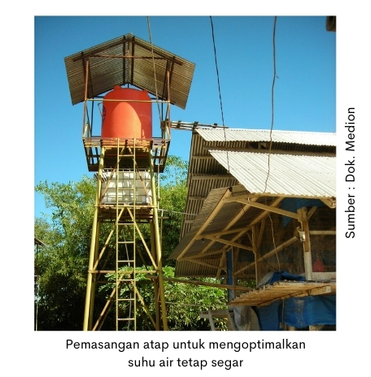
- A close-up of the roof (Neo Antisep/Antisep)
- Feed and drinking places should be washed and disinfected regularly with Medisep. Do it anyway flushing to clean moss or biofilm which is attached to the water pipe.
- Limit contact between commercial poultry and free-range chickens, waterfowl or wild animals.
- Control pests or disease-carrying vectors such as mice and flies. Use mousetraps and to reduce the population of flies can use Flytox.
- Water in a pot of boiling water (Desinsep).
- Check drinking water quality regularly. The drinking water provided is sourced from clean, always fresh and safe water. It is necessary to regularly control and check drinking water sources at least during the change of season.
5. Monitoring antibody titer needs to be done regularly, especially for laying hens and breeders to determine the success of vaccination and monitor antibody titer during production. Especially to control viral diseases (examples such as ND and AI), some farmers can routinely monitor antibody titers through serology and PCR tests to help confirm the diagnosis.
6. In order to increase the amount of protein in the body, it is necessary to take a multivitamin (Vita Stress/Fortevit) on a regular basis. In addition, the administration of vitamin C in Vita Stress can reduce the impact of stress on chickens. Supportive therapy (Kumavit, Heprofit) and immunostimulants (Imustim) is needed in these conditions to protect the liver from damage and maintain chicken immunity so that chickens are always healthy and optimal productivity.
7. Improvement of quality and quantity of feed (feed given must be in accordance with the number and content of nutrients) according to the needs of livestock to get good chicken performance. If possible, test the quality of feed in the laboratory (MediLab) to ensure that feed nutrients have met the needs of chickens.
8. Ration storage areas need to maintain temperature and humidity conditions, and avoid pests such as mice and other insects. Ration replacement is also carried out gradually to minimize stress in chickens. Do it monitor against the consumption of rations and doing periodic flipping rations to increase appetite.
9. Added mold inhibitor Fungitox to inhibit the growth of fungi. And no less important when humid conditions, especially during the rainy season, you should use toxin Freetox to bind mycotoxins in feed. In addition, also provide premix supplementation such as Mix Plus to optimize productivity.
10. Recording (recording) on farms it is important to be able to monitor the health status of poultry.
11. Farmers can start to try to include alternative products other than antibiotics in routine health programs so that disease prevention and treatment are more optimal. Products that can be given several of them Ammotrol, Kumavit, Imustim, Gingertol, Eggstima, Fithera, Respitoran, Heprofit, Grow Chicks, and Fasbro.
In addition there are other products such as Asortin made from organic acids to help improve performance and maintain the digestive health of chickens. And also Entrozyme products containing lysozyme as growth promoter to improve the condition of the gastrointestinal tract and improve the performance of poultry.
Failure holds many valuable lessons. From the evaluation of poultry disease is expected that we can learn to maximize all our efforts in achieving better maintenance targets. May be useful.