High egg production is the main target for laying hen farmers. This will be reflected in the achievement henday dan egg mass. Based on data from ISA Brown Manual Guide (2020) we can know that the peak production target is 96%, with egg hen housed 420 points and egg mass hen housed reaches 26.4 kg.
Not only henday, the breeder also needs to pay attention to the quality of the scion. No matter how high the egg production, but if the quality of the shells is not optimal, farmers will find it difficult to market their eggs. The shellfish is of good quality, which is thick (no cracks) and has a good brown color.
Eggshell Color Quality Unit
The color of egg shells that Indonesian people like is shiny brown. The more brown, the eggs will be assumed to be of good quality. So far, the determination of shellfish color only uses the perception or visualization of consumers.
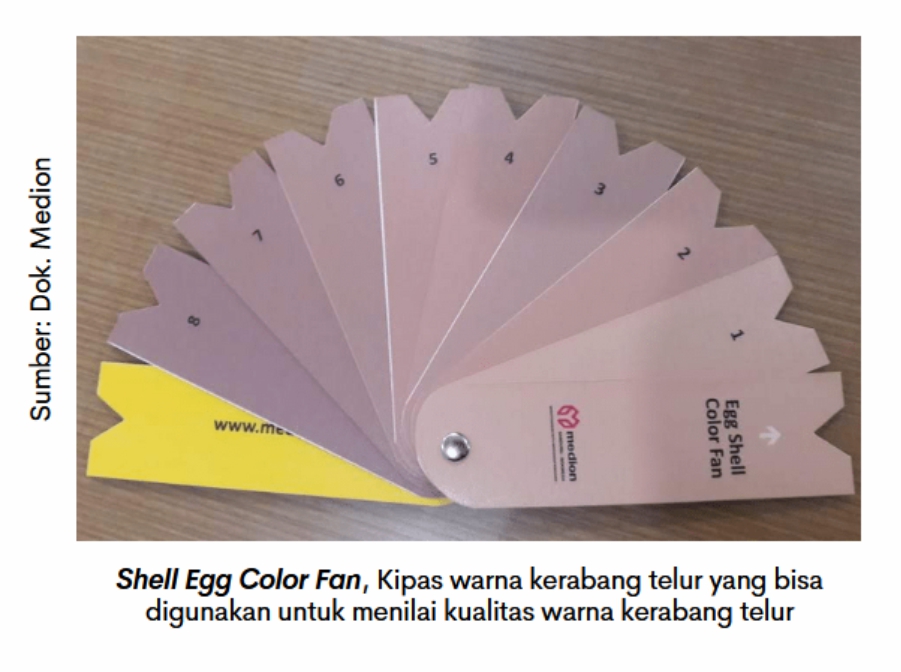
Egg Shell Color Fan or the eggshell color fan becomes one of the tools to determine the level of eggshell color. The higher the value, the more good quality eggs.
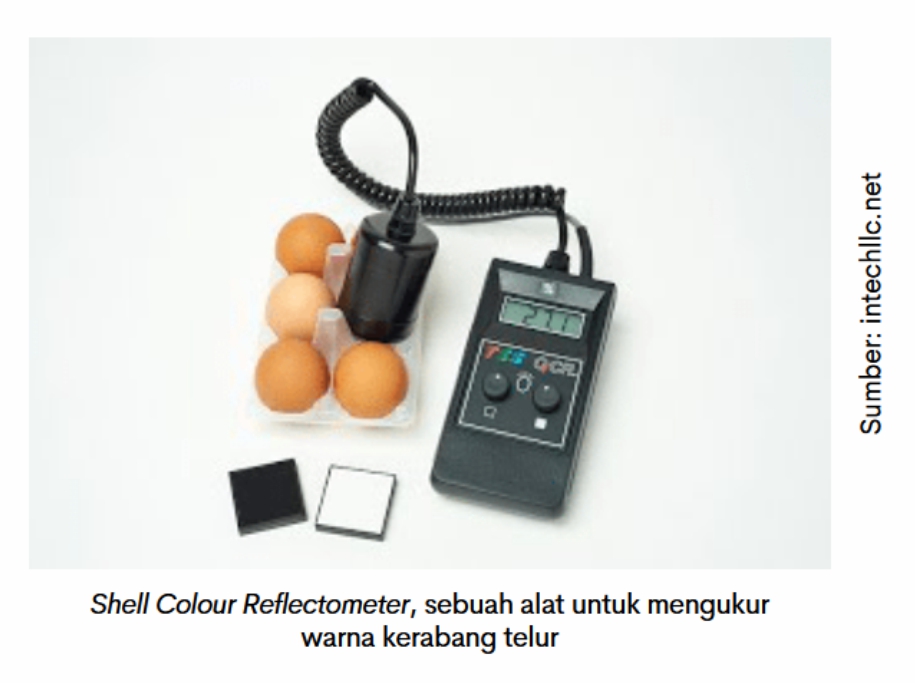
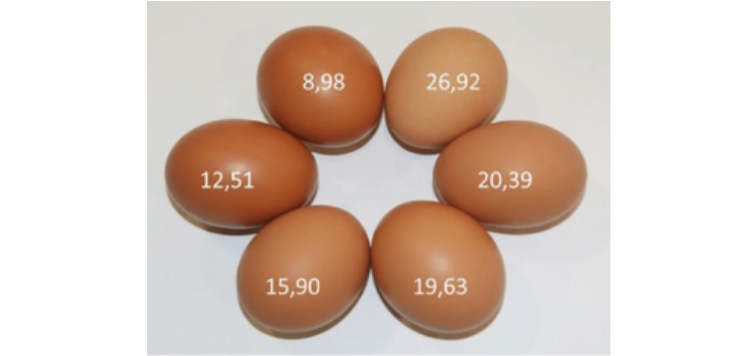
Hendrix Genetics which is a laying hen breeding company It's Brown using a reflectometer to measure the color of eggshells. This reflectometer works by taking the percentage of color from black (0%) and white (100%). For a good shellfish color has a value of 25-40%.
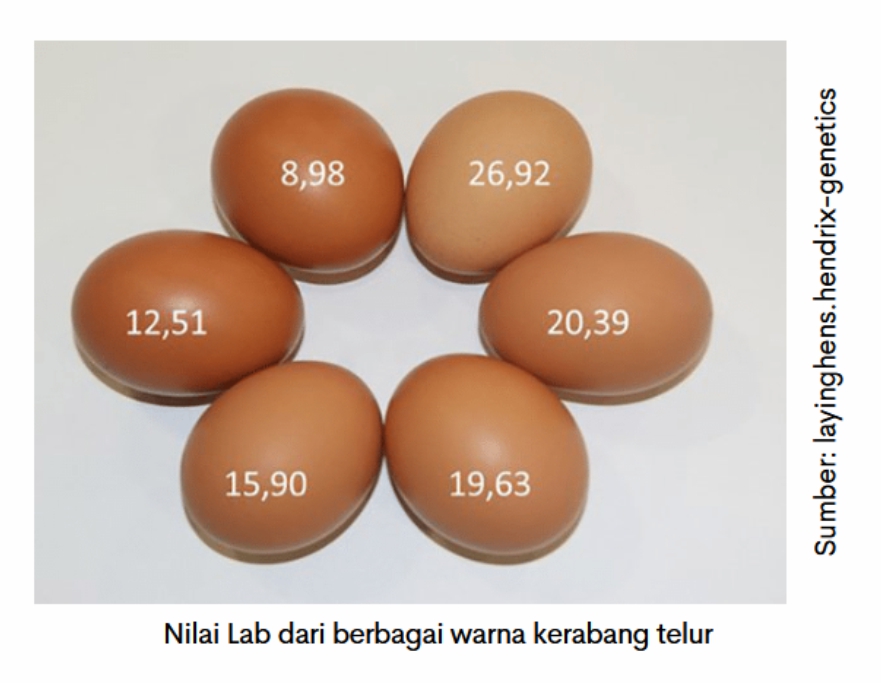
Currently used Lab, the unit of color quality of eggshell. The measurement uses a chromameter whose method is more detailed in detecting the color of eggshells. This tool is also used in general for color measurement, ranging from meat color and vegetable color. The range of Lab values is different from the refrectometer, the lower the Lab value, the darker the color of the egg shell. It's Brown standardize the color quality of a good eggshell is 17.0 Lab.
Quality Of Laying Hens
Chicken conditions that need to be considered related to the quality of egg shells are :
- Quality of bone skeleton. This can be seen from the large and long leg bones and the width of the collarbone (os pubis). Long and large bones of the foot (shank) and the width of the collarbone illustrates the presence of abundant calcium deposits. Chickens with small leg bones and collarbones tend to produce eggs with a pale size and color.
- Cache size and gizzard (Gizzard). Cache and gizzard is 2 organs that serve as storage (depot) rations. The optimal size (large), will cause the Food Depot to meet the needs of chickens to be more. This is important, considering that the process of shellfish formation occurs longer at night, when there is no more feeding activity. Whereas that's when calcium as the main component of the main constituent of shellfish is needed in sufficient quantities.
Give Rations Pre Layer
Ration Pre Layer developed specifically to help phase chicken adaptation grower which will soon enter production. A very high difference in calcium levels, which reaches 400% between rations grower and layer often an obstacle for chickens to increase feed intake- her. This will be seen during the early to peak production, feed intake difficult to achieve. One of the causes of this is a very significant increase in calcium levels. Moreover, this dosage form of calcium also differs between rations grower and layer. On feed grower calcium preparations are supplied in the form of mash or small granules (1-2 mm in diameter). As for the feed layer administered in the form of large granules 3-5 mm in diameter.
Ration feeding pre layer it also serves to optimize the development of medullary bone (medullary bone). This medullary bone serves to supply calcium for the formation of egg shells. The development of the medullary bone is not optimal, will result in the quality of the eggshell is not good, ranging from easily cracked to pale color.
Ration feeding pre layer this should be done 2 weeks before the chickens start laying eggs. This can be done by giving a special ration pre layer and mixing between rations grower and layer which is done gradually. The average farmer is late in changing his ration. Usually, when the chickens have laid new eggs, the ration is changed. As a result, chickens do not get the calcium supply as needed. Paralysis of laying hens at the beginning of the production period is one of the consequences of this delay in calcium supply, especially if during the pullet there is a delay in growth.
Calcium in addition to functioning to form bones and eggshells also function for muscle contraction. Low levels of calcium in the blood will make the chicken weak. This condition will get worse if egg production is high and the target feed intake not achieved.
Calcium Particle Size
In addition to the content in the ration, which must correspond to the needs of the laying hens, the particle size of the calcium source ration material must also be considered. This is related to the long time of the eggshell formation process, which reaches 18-20 hours. Particle size of calcium source raw materials, such as limestone (flour or grit stones), shells and bones must be considered. It is associated with a retention period or a long period of stay in the digestive tract (cache, gizzard and intestines).
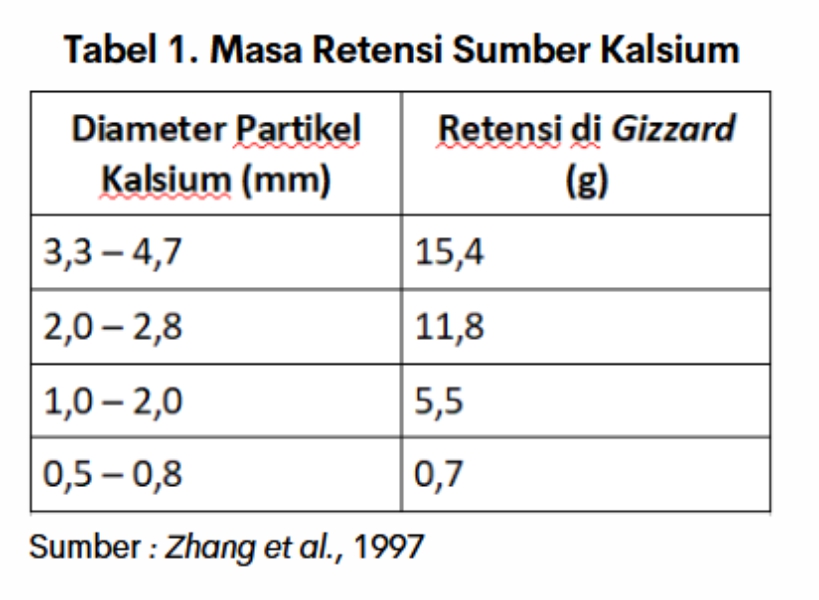
The long process of eggshell formation requires a supply of calcium that can last a long time. Table 1 shows the data that calcium preparations take the form mash or the powder will be more quickly removed from the digestive tract. This will result in a lack of calcium supply for the formation of shellfish. And it could be that calcium will be removed a lot with feces. While the source of calcium in the form grit or the details will be able to last a long time inside gizzard so that it can be released slowly at night for the formation of eggshells.
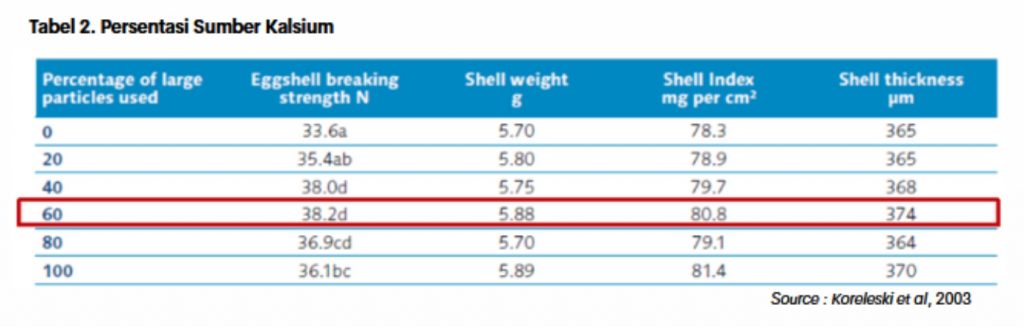
Then, is the source of calcium given in the form of granules all? No, the source of calcium is in the form of mash (powder) is also necessary for the re-formation of the medular bone, which takes calcium during the formation of eggshells at night. Therefore, this source of calcium should preferably be given in a combination of two preparations, namely powder and granules. Table 2 shows the data that the combination of preparations grit or granules as much as 60% produce the best quality of eggshells. Recommendations for providing calcium source raw materials are given in 2 preparations, namely 30-40% in the form of powder while 60-70% are provided in the form of granules (grit).
Applications mid night feeding or giving rations at midnight can also improve the quality of eggshells. Midnight feeding this can be done for 1-2 hours, starting at 01.00.
Feeding Management
Feeding should be done 2 times a day, ie morning and afternoon with a ratio of 30-40% feed for morning feeding and 60-70% for daytime feeding. It is expected that during the day, there is an empty time for the ration so that during the day feeding (60-70%) the chicken's appetite increases. The purpose of giving more day or afternoon is to help the availability of nutrient supply (especially calcium) at night so that the quality of the shells becomes more optimal. If necessary, you can add 2-3 grams/head / day of calcium sources (grit stones with a size of 2-4 mm) in the afternoon (eg hours 15.00-16.00)
Homogeneity (Flatness) Of Feed
Calcium sources, such as flour or grit stone, bone meal usually has a greater weight than other feed sources. This condition will greatly affect the homogeneity or flatness of the feed mixture. When in the machine mixer, grit stone will go down faster than other raw materials. Therefore, it is necessary to optimize for the most appropriate length of time for mixing. When the stone flour is uneven distribution, then the quality of egg shells produced will be very varied.
Environmental Conditions
Environmental conditions that need to be considered are air temperature, CO₂ and O₂ levels. When the temperature is hot, the chicken will tend to decrease appetite so that nutrient intake is not achieved. This will lead to a decrease in egg production (HD drops) and a decrease in the quality of shellfish.
In addition to temperature, what needs to be noted is the rate of CO₂ and O₂. These two components
must be balanced in the blood. CO₂ levels are very necessary for the formation of eggshells which in fact the main content of calcium carbonate. Calcium comes from feed, carbonate comes from the content of CO₂ in the blood. When chicken panting will cause CO₂ levels to be lost in the blood. Whereas o₂ levels will help hemogoblin function optimally in carrying feed nutrients.
Although in the cage closed house, noteworthy are wind speed or wind speed. Wind speeds that are too fast will cause chickens to lose O₂. The consequences are sometimes chicken pantingthis will affect the quality of the eggs. It is necessary to check the wind speed in each part of the cage, starting from the front, middle and back. Then later we can also compare the quality of the eggshell. Whether the White kerabang is found in the front, middle or rear cage.
High egg production must be accompanied by optimal eggshell quality, both from the color and strength of the eggshell. Greetings.