Implementation of good management will be the key to success in the process of raising chickens. One of the important components in good management is the activity of recording maintenance performance or commonly known as recording maintenance.
Recording is one form of business that we can do to document the activities and conditions of chickens every day during the maintenance period. Recording it is important because the data that is successfully documented can be used as evaluation material both for the ongoing maintenance period and for the next maintenance period.
Importance Recording Preservation
Recording maintenance is done well and consistently has several benefits, including :
1. Evaluating maintenance management
When there are obstacles to achieving performance such as body weight that is not achieved, it can be evaluated by looking at recording maintenance. Some parameters are in form recording it could be related to each other. For example when the body weight does not reach the standard then we can see and evaluate whether feed intake have reached the standard or not. When feed intake also do not reach the standard, then we re-evaluate what is the cause. It could be due to environmental conditions that are not suitable (high temperature and humidity) so as to make the chicken uncomfortable and affect feed intake as well as resulting in the achievement of body weight that does not match the standards. Therefore, the data in recording maintenance is very useful to be used as a reference to trace the root cause of problems in maintenance as well as evaluation material.
2. Become database medical history
Cage information or flok who is being attacked by the disease will help us in preparing a visit schedule. The visit must be made from a stable or flok healthy chickens then into the cage or flok sick chicken. Without recording good maintenance it is not impossible that the opposite will happen and have an impact on the transmission of disease between cages or flok.
In addition, the data in recording such as production performance, pattern of chicken deaths, achievement feed intake, the use of OVK, disease history, and other data can be used as initial information in diagnosing the disease. From that information, we as farmers can make improvements and evaluate health programs, especially in determining vaccination schedules, hygiene programs, and cage disinfection. Thus, of course, the hope is that in the next period the cases of this disease will not recur.
3. Mapping the history of disease attacks
Recording neat and consistent maintenance at each period is useful to document cases of disease events that have occurred. The type of disease that attacks chickens in a particular month or season can be seen in the history so that prevention measures are more accurate. In addition, the pattern of disease attacks that occur in one flok can also be mapped.
Components Recording Preservation
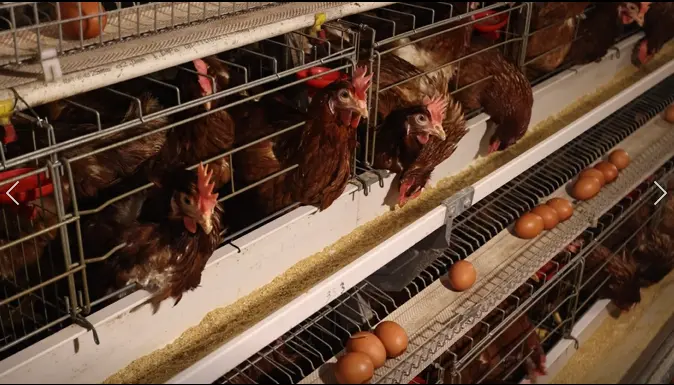
The concept of recording maintenance is to record all aspects of the performance, activity, and condition of the chicken and the cage environment during the maintenance period. Implementation recording commonly done is to perform manual recording on form recording left in the cage area. But as technology develops, some farmers have also used digital worksheets such as microsoft excel or spreadsheet. There are also breeders who use special applications recording because it is considered more practical and the information can be monitored realtime.
The following are the components recording should be carried out routine data collection during the maintenance period:
1. Population
The number of chicken populations that are kept is important initial information to know. This is because the population data is closely related to the calculation of feed needs and treatment doses.
2. Depletion
Depletion covers dead chickens, culling, or lost. Every day the chicken depletion data must be updated because it affects the remaining chicken population so that the number of feedings or drug doses can be adjusted again.
3. Feed Intake
Data feed intake it is necessary to know the amount of ration consumed by chickens on the day and take care of the availability of ration stocks in the barn. By doing data retrieval feed intake we can compare the feed consumption of chickens real with the standards issued by the nursery company. This Data is very useful for monitoring expenses and evaluating the achievement of chicken performance.
4. Production performance
This production performance component will be the difference between recording preservation broiler and maintenance layer. On maintenance broiler, the focus of production performance is the achievement of high body weight with efficient use of rations. Therefore, important information entered in form recording namely body weight and FCR.
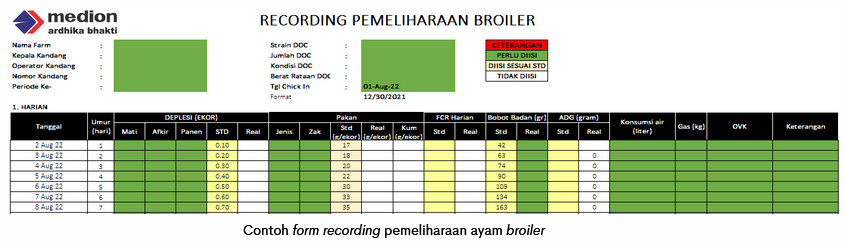
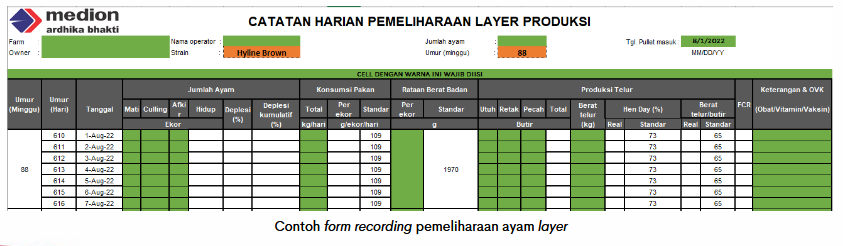
While on maintenance layer the number of eggs per egg, the number of eggs per egg, and the number of eggs per egg (hen day) and egg weight. All of this information (broiler and layer) becomes very important because it determines the size or small profits obtained from the results of maintenance.
5. Environmental conditions
Recording environmental conditions is also important. It is these environmental conditions that determine the comfort level of chickens in the cage. Changes in environmental conditions such as temperature and humidity need to be followed by management adjustments, especially related to ventilation. Management Open and close the curtains on the cage open house or the determination of the fan flame on cage closed house determined by environmental conditions. Information on environmental conditions can also be used as one of the considerations for other maintenance management such as feeding time or cage widening.
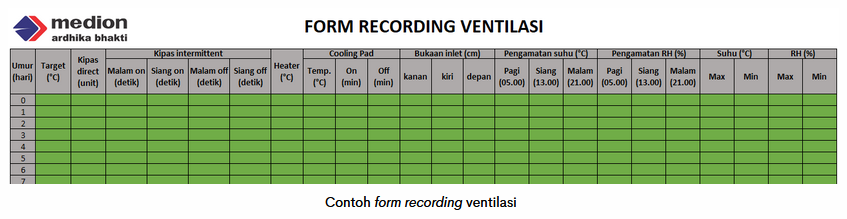
6. Health programs
Recording the history of treatment included in the history of the disease is necessary to evaluate the program and develop a health program. As an example in the use of antibiotics it is advisable to perform rolling to prevent disease agent resistance.
To facilitate the control of its use it can use data recording treatment history as the basis for reference.
Form recording is generally filled by the cage operator and assisted by the head or cage manager in evaluating it. Joint commitment and high discipline is needed in filling form recording maintenance in order to collect complete information that can be used as database maintenance.
Recording accurate will make it easier for farmers to evaluate and control the development of performance produced by chickens. Recording simply made in a simple but neat and requires discipline cage children to do the recording from time to time. Good luck.