Pak Bagus
E-mail: Bagus.saputra@gmail.com
What medications can I give when my chickens have coccidiosis and CRD at the same time? How is the selection of anticancer drugs and antibiotics? and what about the best apps?
Answer :
Dear. Good sir, thanks for the question. Previously we will provide a little information related to coccidiosis disease and Chronic Respiratory Disease (CRD). Coccidiosis is a disease caused by protozoa Eimeria sp. This coccidiosis disease causes clinical symptoms in the form of weak, lethargic, pale chickens and accompanied by bloody stools. While CRD disease is a disease caused by bacteria Mycoplasma sp. Clinical symptoms of chickens attacked by CRD will show mucus discharge from the nose, decreased appetite, and snoring.
If both diseases occur simultaneously, then you can use the drug Therapy or herbal products namely Medion Fithera. Where both products can overcome bacterial diseases such as CRD and coccidiosis simultaneously.
Therapy is broad spectrum therapeutic agent where to work bacteriostatic or inhibit the growth of bacteria. In addition to antibiotics, Therapy can also cope with coccidiosis. In addition Therapy, Medion has herbal products Fithera which can be used as antibacterial as well as anticoxy as well. The advantages of herbal products are safe, leave no residue and do not cause resistance.
Mechanism of action Fithera as an antibacterial that binds bacteria and makes bacteria leak so that the bacteria die. While the mechanism of action Fithera as an antioxidant that works by inhibiting cleavage sporozoites which has entered the intestinal cells and also works by lining the intestinal cells so that the intestinal mucosa cannot be infected by Eimeria sp.
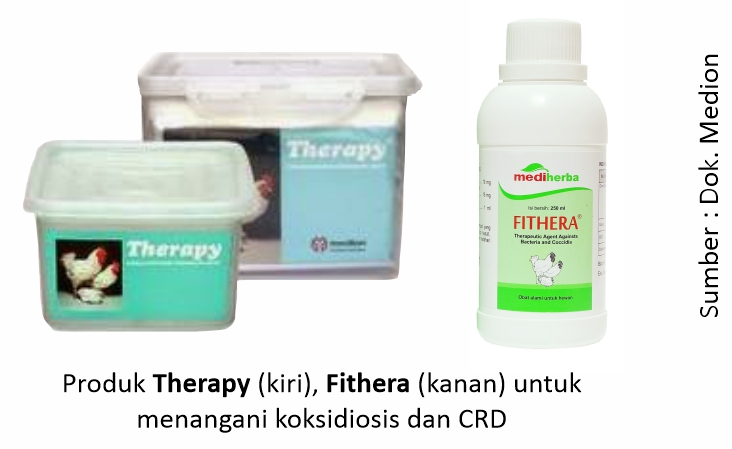
Good Drug Administration application Fithera or Therapy it can be given through drinking water. Dosage Therapy IE 0.2 gr / kg BB for 5-7 days while the dose Fithera to deal with bacterial diseases as well as coccidiosis is 0.4 ml / kg bw for 7 consecutive days.
In addition to the treatment needs to be supported by some of the following:
- Isolate sick chickens to minimize disease transmission.
- If possible, remove feces mixed with blood that is on litter to avoid other chickens pecking at it. This is because the red color of the feces will attract the attention of other chickens to peck and there is a process of transmission of coccidiosis.
- Do not administer coccidiosis treatment at the same time as products containing B vitamins or amino acids, as B vitamins are nutrients for the protozoa that cause coccidiosis. Vitamin B can only be given after treatment is complete / finished.
- Culling chickens in severe condition
- Especially for broilers, if cases of disease occur at the age of >25 days and the price of chicken on the market is good, it is recommended that the chicken is harvested only.
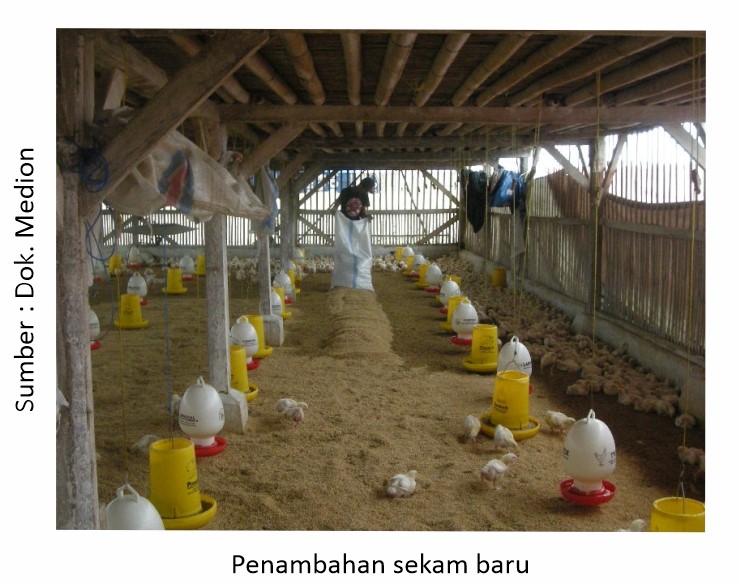
- Pay attention to the condition litter- husks, don't get damp or wet. Add a new husk if the husk is already very damp. If necessary, add lime to the newly added husk.
So that this incident does not recur in the next maintenance period, it can be done several ways such as:
- Sanitationcages and farm equipment (cages cleaned, washed and sprayed with Antisep, Formades or Sporades). But for oocysts Eimaria sp relatively resistant to disinfectants. In addition oocyst it is also difficult to eradicate because of its very small size so it is easily blown away by the wind and scattered everywhere. Even so, there are still ways we can use to eradicate oocyst. The method is to give lime or caustic soda on the surface litter or wet, wet feces. When both materials are dissolved in water or wet media, high heat will be generated. Temporary, oocyst not resistant to extreme heat >55°C.
- Apply farm management properly, so that chickens are safe and protected from the threat of disease. Adjust the ventilation and density of chickens in the cage.
- Use litter with an initial thickness of about 8-12 cm for postal cages and 5-8 cm for stage cages. Replace immediately litter the wet and clumping. If the amount litter a small lump, then it can be sorted and removed from the cage. However, if the number litter that clumps or wet already a lot, better stack with litter the new to the lumpy does not appear.
- Chickens suffering from CRD can act as carriers of the disease, so young chickens should not be kept near Old chickens and broilers kept separately from laying hens.