Mr. Meris
Riau
At the time DOC came, physically look active and agile. But after the age of 15 days my chickens do not grow normal or stunted. This has already happened in 2 times the maintenance period. At the age of 27 days of carcass surgery, pale liver, intestines filled with watery yellow liquid and gizzard there is an undigested ration and there are black grains like stones. What diseases attack? How to handle it?
Answer:
Accept Dear Mr. Meris, for your question. First we will discuss the causes of dwarfism in chickens. Dwarf-bodied chickens can actually be caused by several factors, such as:
- Quality DOC. The quality of DOC can be influenced by genetic factors, small hatching eggs from young parents (less than 25 weeks), maternal antibodies against Reovirus low, nor the parent of a positive DOC infected with bacteria Salmonela enteridis.
- Management factors. Time brooding period, very influential on the growth of chickens because of the development of all organ cells, such as the immune system, digestion, respiration and thermoregulation. Examples of current ration availability chick in and achieved feed intake will affect the size and length of the intestine.
- Ration factor. The quality and quantity of the ration has an effect on the growth of chickens. The quality of rations can be reduced due to the presence of fungi and mycotoxins that can reduce nutrient content. In addition, the presence of mycotoxins can irritate the digestive tract so that the process of absorption of nutrients in the chicken's body is not optimal. In addition to the quality of the ration, the lack of quantity/amount of ration intake and drinking will cause competition between chickens. The impact is that the amount of ration that enters the chicken's body is less so that the growth of body weight is not uniform.
- Stressful conditions. When chickens stress hormone production ACTH (adrenocorticotropic hormone) increases, so that the process of metabolism and absorption of nutrients from the ration becomes not optimal. The lack of appetite of chickens due to stress causes their body weight to be unattainable or not uniform.
- Disease attacks that can cause dwarfismOne of the viruses that are often found to cause dwarfism is Reovirus and the disease is called helicopter disease or Runting and Stunting Syndrome (RSS). Reovirus will infect villi-villi epithelial cells of the small intestine that cause intestinal function disorders such as indigestion and absorption of fat, fat-soluble vitamins and carotene, so that the target body weight is not achieved. Helicopter disease mainly found in chickens broilerit can also affect chickens layer and breeder. The disease appears from the symptoms of non-uniform growth, with an incubation period (the process of the virus entering until the appearance of clinical symptoms) for 10-14 days.In the carcass surgery, it was found that the stomach appeared to expand and Harden (this condition is clearly seen in chickens aged 3-4 weeks). This is due to the fact that the digestive tract contains undigested rations. Enlargement of the proventriculus accompanied by tissue death and bleeding and mild intestinal inflammation. In some cases, infected chickens Reovirus this indicates a clear change in the color of the carcass meat that appears pale.
Seeing the picture of the condition of the father's chicken is associated with the triggering factors of dwarfism above, the events experienced by the father's chicken leads to disease Runting and Stunting Syndrome. This is reinforced by the presence of smallness from the age of 15 days (the possibility of chicken infection during DOC, given the long incubation period of 10-14 days) with undigested feed in the proventriculus/gizzard. The presence of black grains like stones in gizzard comes from the form of grit or blood clots that have long been due to bleeding in the proventriculus. In addition, the pale color of the liver can be caused by a lack of supply of carbohydrates, fats, proteins, and vitamins for metabolic processes through the bloodstream, due to the lack of food nutrients absorbed in the intestine.
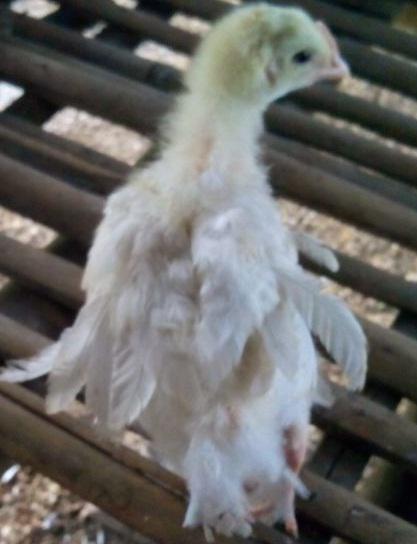
Other specific signs found are abnormal feather growth on the primary wing feathers. In addition, the growth of feathers is also irregular, causing the feathers to appear to stand like a propeller and create the impression as if the chicken looks like a helicopter.
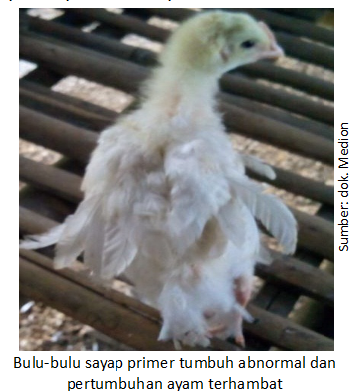
This dwarfism syndrome can be divided into 2 categories, namely the category runting (penularan ayam ke ayam) dengan kasus <5% dari populasi. Sedangkan kategori stunting the figure can reach 50% (in the range of 5-50%) of the population. If in the case of stunting it was found that the body weight of chickens is very far from the standard because of dwarf chickens since they hatched, so it is better to do an early harvest of whole chickens. Meanwhile, in the case of runting syndrome it is generally associated with maintenance management. On farms with good management, usually the percentage of cases runting relatively small.
If the case of dwarfism is still in the category runting, immediately do the selection (culling) and reject chickens that look stunted, especially those whose weight is 40% below the standard. While dwarf chickens with a body weight that is not too far less than the standard, can be separated and then given special treatment, including:
- For example, the number of amino acids and minerals (Mix Plus or Top Mix) to spur optimal growth until body weight reaches 1-1 .2 kg and chickens are worth harvesting.
- The use of anti-inflammatory drugs (Amoxitin, Neo Meditril or Collimezyn).
- The best way to increase muscle mass is to increase muscle mass (Neobro, Broiler Vita or Fortevit).
- Regular sanitation and disinfection of the cage (Antisep or forms when the cage is empty).