Bapak Indra
Surabaya-East Java
I keep chickens broiler, on the 2nd and 3rd week I give Broiler Vita. Then, in time it happened heat stress, how to cope with the condition? If I want to give Vita Stress, can I mix Vita and Vita Stress broilers in 1 drinker? If it is divided, what kind of division. Thank you.
Answer:
Heat stressheat stress) is a stress disorder that occurs due to environmental air temperature conditions exceeding normal temperature (>28°C) so that chickens are unable to balance between the production and disposal of body heat. Please note that the comfort zone (comfort zone) chickens are in the temperature range of 25-28°C with a humidity of 60-70%.
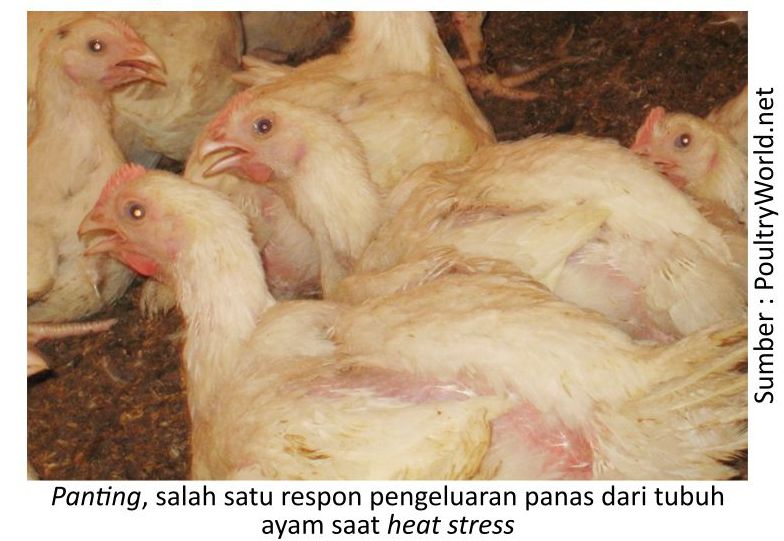
Consequences that can be caused when chickens experience heat stress is an increase in drinking water consumption and a decrease in ration consumption. This is done as compensation for activities panting chicken.
Decrease in ration consumption will have an impact on increasing ration conversion (FCR) and weight loss in chickens broiler, chicken rearing broiler up to 35 days of age at temperatures above 31°C can cause weight loss of up to 25% at harvest when compared with maintenance at a comfortable temperature of 25-28°C. If not quickly overcome it will lead to death.
It should be noted efforts to overcome heat stress in order not to happen protracted and detrimental to farmers can be done as follows:
- Provide cold water temperature 20-24°C good quality. Cold water can be used to help chickens stabilize their body temperature when the ambient air is high.
- Do chicken thinning. Thinning in one cage aims to reduce the density so that the chicken feels more comfortable, not too hot, dense, and can freely radiate heat from the body to the environment.
- Adjust the treatment to environmental conditions, for example, do not vaccinate, cut the beak (debeaking) or other treatment when the ambient temperature is high, as this can further aggravate the condition heat stress.
- It is best not to give rations during the day when the temperature conditions are high, because it can cause death due to the high activity of digestive metabolism and the generation of a lot of body heat.
- Arrangement of ventilation by opening all the curtains during hot weather, so that the circulation of hot air to be quickly replaced with cold air.
- Notice litter, cause litter which is not feasible to be a source of heat without us knowing, through the fermentation system that is on litter itself. Examples litter what is no longer worthy is litter wet and lumpy, if litter a small lump, then it can be sorted and removed from the cage. However, if the number litter the lumpy or wet is already a lot, it is better to give litter the new one.
- Increase biosecurity. When the temperature is high, the development of disease seeds in the drinking water reservoir becomes faster. Therefore, the schedule of cleaning and disinfection of drinking water channels should be more routine. So is the disinfection of the cage. When there are chickens choose safe disinfectants, such as Antisep, Neo Antisep or Medisep.
- Give vitamins and electrolytes. The most important Vitamin is vitamin C. Examples of Medion multivitamin products that can be used in dealing with stress in chickens are Vita Stress or Kumavit because they are both complete, they contain vitamin C as well as electrolytes.
To overcome heat stress, we recommend temporarily replacing Mr Broiler Vita with the Vita Stress. Usage Broiler Vita can be continued after the symptoms of stress in chickens have subsided. Broiler Vita it is a vitamin that serves to improve the conversion of rations and fatten chickens broiler.
Broiler Vita also contains Vitamin C, but does not contain electrolytes. Then after the chicken condition is normal, Broiler Vita can be re-used.
Other alternatives that can be used besides Broiler Vita include Neobro. Neobro contains vitamins and amino acids that can accelerate the growth of broilers, reduce mortality and increase the use of rations.