The use of protein sources plays a crucial role in feed formulation. This is due to their role in growth, tissue formation, and involvement in various metabolic functions. The largest protein sources generally come from processed soybeans, such as soybean meal. However, with the development of soybean meal, more and more feed ingredients derived from soybean processing, such as full-fat soy or full-fat soybeans, are being used.
A. Getting to Know Full Fat Soy
Full-fat soy, or full-fat soybean, is a feed ingredient derived from soybeans that is heated at an optimum temperature for a short period of time without oil extraction. This heating process aims to reduce antinutrients, break down cell wall components, and increase the efficiency of protein and fat digestion (Zahran et al., 2024).
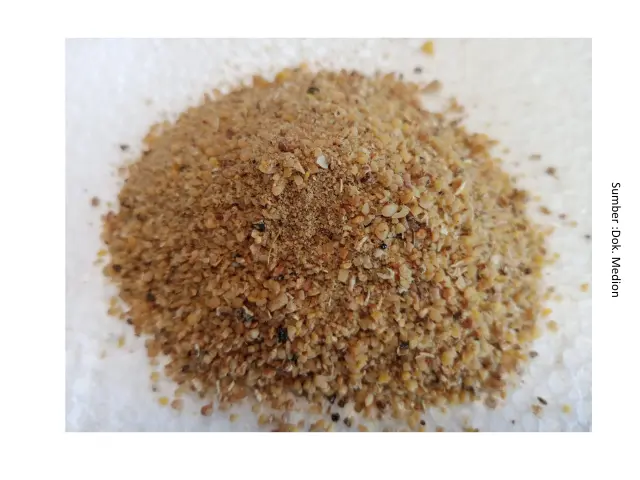
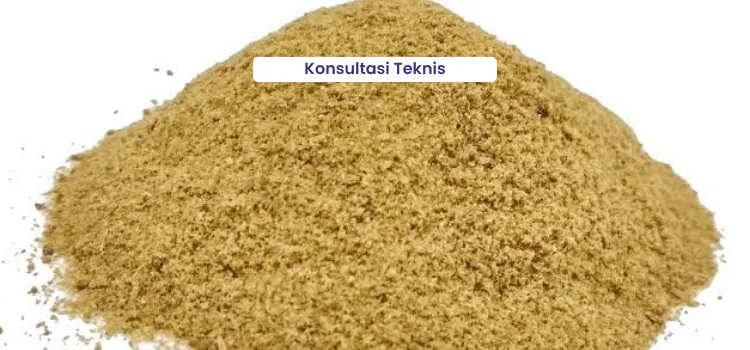
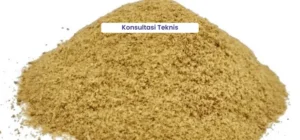
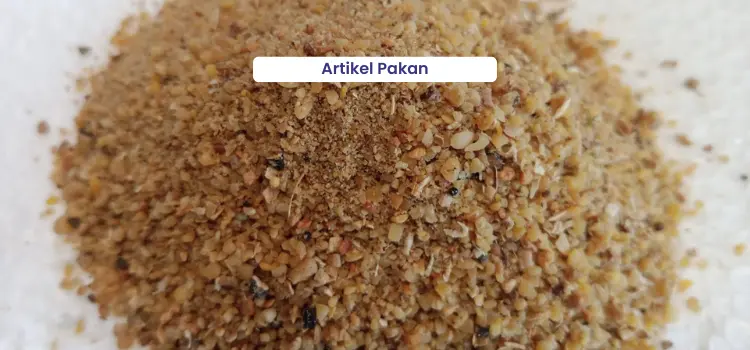
In general, full-fat soy exhibits physical (organoleptic) characteristics such as a bright brown or yellowish color, a distinctive soy aroma, and a coarse, grainy texture (Feed Reference, 2003). The organoleptic quality of full-fat soy can be influenced, among other things, by the manufacturing process. Temperature and heating time are critical factors to consider in relation to the reduction of antinutrients and protein quality. This is because protein is sensitive to high temperatures.
The success or failure of the heating process can be determined by the resulting full-fat soy color, which is dark brown or similar to soybeans. Dark brown occurs due to the Maillard reaction, indicating that the full-fat soy has been overprocessed or overheated. Excessive heat reduces protein quality and amino acid availability. According to Heger et al. (2016), lysine is a highly susceptible amino acid because it has an exposed ε-amino group and readily reacts with reducing sugars.
Meanwhile, a soybean-like color indicates that full-fat soy has been underprocessed, potentially preventing the breakdown of antinutrients (Javed et al., 2022). One antinutrient that is resistant to processing is lectin. Lectin is an antinutrient that inhibits the absorption of fat in feed and will form bonds with the intestinal mucosa, causing hyperplasia and damaging intestinal villi (Mirghelenj et al., 2013). Based on a study conducted by Javed et al., (2022), it was concluded that ideal heating is carried out at a temperature of 90oC for 45 minutes, with results without affecting the quality of full-fat soy and able to improve performance in broiler chickens.
B. Nutritional Content of Full Fat Soy
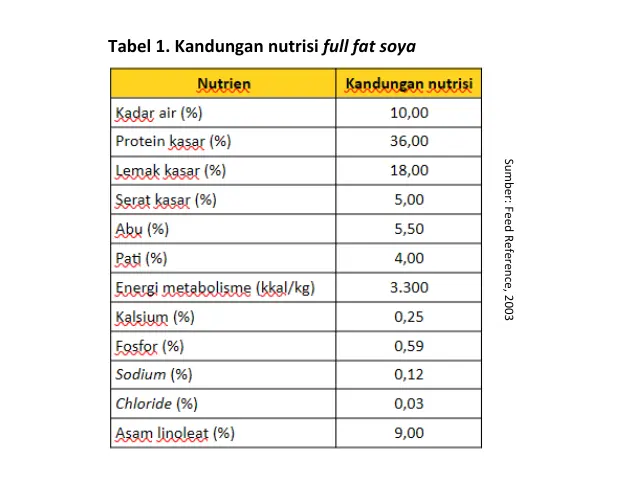
The nutritional quality of full-fat soybeans in the field can vary due to differences in soybean quality, manufacturing process, and storage management. Full-fat soybeans can be used as a protein source because their crude protein content is >20%. The complete nutritional profile of full-fat soybeans can be seen in Table 1. Table 1 shows that in addition to their high crude protein content, full-fat soybeans are also high in crude fat and metabolizable energy.
During the laying period, the mobilization and synthesis of lipids, or fats, in the hen's body are in a dynamic balance. Laying hens obtain approximately 3 grams of lipid from their feed per day, while the amount of lipid required for the formation of each egg is 5–6 grams. Therefore, some lipids are synthesized endogenously by laying hens and then stored in the ovaries via the circulatory system to ultimately form the egg as yolk (Gao et al., 2021).
Full-fat soy is rich in fatty acids. The fatty acid composition of feed directly affects egg yolk composition, one of which is linoleic acid. Linoleic acid is an essential fatty acid needed by the chicken's body and influences egg size and weight. This occurs because linoleic acid is stored directly in the yolk, increasing egg weight by increasing the yolk's weight (Kostik et al., 2015).
Another study found that linoleic acid plays a crucial role in the growth and reproduction of laying hens. According to Gao et al. (2021), linoleic acid deficiency significantly impacts growth and development, affecting ovarian development, and reducing body weight, egg weight, and hatchability of fertilized eggs.
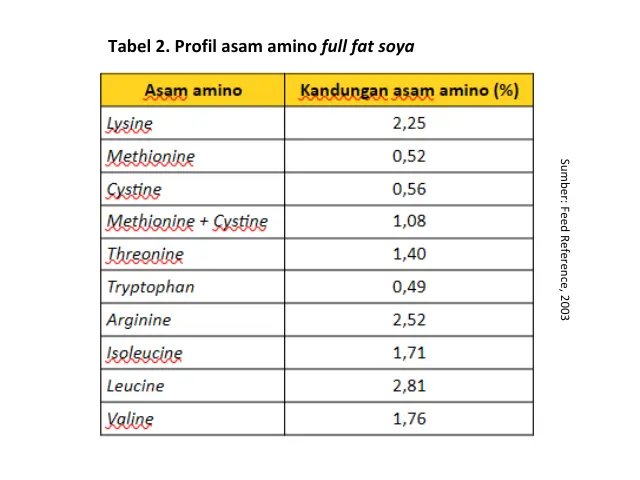
In addition to being rich in nutrients and fatty acids, full-fat soy also has a complete amino acid profile. The amino acid profile can be seen in Table 2.
C. Utilization of Full Fat Soy in Chicken Feed
The use of full-fat soy as a feed ingredient has been widely studied in previous research and is currently being developed for use in livestock farming. Rada et al., (2017) observed that the use of 8% full-fat soy in grower chicken feed had no negative effects on growth and FCR values. Zahran et al., (2024), evaluating the use of full-fat soy up to 20% in finisher feed, showed that body weight and carcass weight were not different from the control feed without the use of full-fat soy. This indicates that the use of full-fat soy does not interfere with the body's metabolic processes and the quality of the resulting chicken carcass.
Another study by Senkoylu et al. (2005) found that substituting full-fat soybean meal in laying hen feed can increase egg weight and improve FCR. Use up to 22% did not negatively impact hen-day percentage, shell thickness, or Haugh unit values. Karimi et al. (2022) concluded that substituting 25% soybean meal with full-fat soybean meal showed a positive response to egg weight and quality. However, substitution up to 50% decreased feed consumption and increased FCR values. This is thought to be due to the accumulation of large amounts of antinutrients.
Saponin, an antinutritional substance other than a trypsin inhibitor, is found in full-fat soybeans. Saponin is more heat-stable and produces a bitter taste. This is a predictor of decreased feed consumption due to saponin residues remaining during the heating process (Zharen et al., (2015).
D. Limits of Full Fat Soy in Chicken Feed
While its use has the potential to replace soybean meal, the limiting factors of full-fat soy must also be considered. Some of these limiting factors and their impacts if given in excess to chickens are discussed.
1. High fat content
Feed ingredients with a high crude fat content are more susceptible to oxidation, making them more likely to go rancid. Oxidation reactions occur when fats or oils react with oxygen, producing organic compounds called aldehydes and ketones, which are the compounds that cause rancidity. Rancidity can reduce energy levels and cause the destruction of fat-soluble vitamins such as vitamins A, D, E, and K (Sari et al., 2019).
2. The presence of antinutrients
Full-fat soy contains the antinutrient trypsin inhibitor. Trypsin inhibitors inhibit the activity of the trypsin enzyme in the body, thereby reducing protein digestibility. This results in suboptimal growth, nutrient deficiencies, and decreased egg production (Mahardhika et al., 2023). In addition to trypsin inhibitors, the high phytic acid content in full-fat soy is also a limiting factor because it negatively impacts the availability of feed nutrients, particularly phosphorus and amino acids (Thanabalan et al., 2021).
3. Quality variations
The processing and quality of the raw materials influence the quality of the resulting full-fat soy. Therefore, regular quality control and judicious use are necessary.
E. Full Fat Soy in Laying Hen Feed Formulation
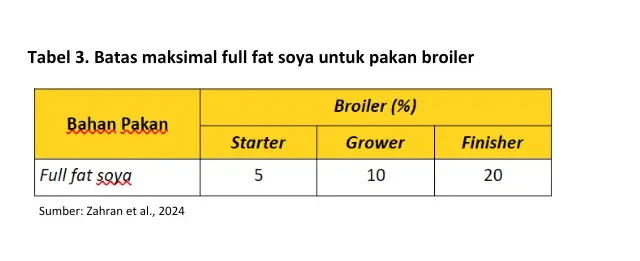
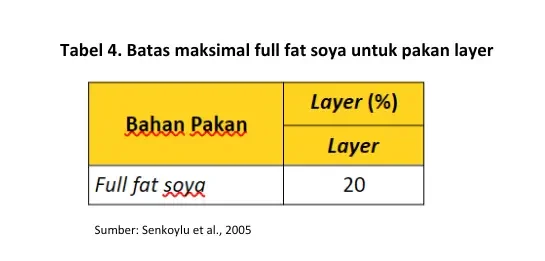
Full-fat soy can be added to feed formulations or used as a substitute for soybean meal. However, its use should be limited. The following are recommendations for use in broiler chickens (Table 3) and layers (Table 4).
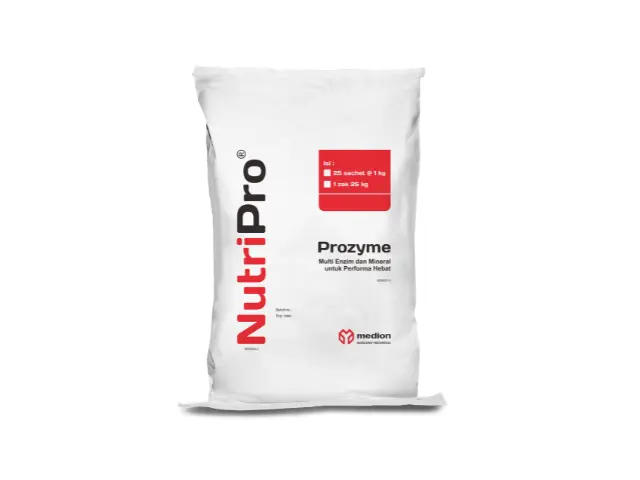
To optimize digestibility, if necessary, add protease enzymes, such as Prozyme, to the feed formulation. Prozyme is a multienzyme that can increase the digestibility of feed nutrients and improve performance and egg production.
An example of the use of full-fat soy in a layer-stage laying hen feed formulation can be seen in Table 5. According to the literature, full-fat soy can be used in concentrations of up to 20-25%. Initial use should be increased gradually. A starting dose of 1-2% is recommended. After evaluating the results, the formulation can then be increased as needed.
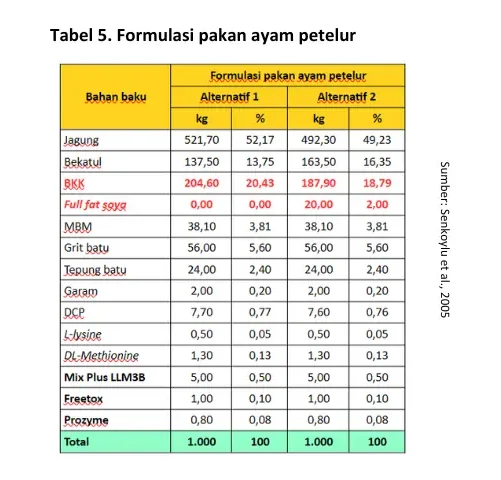
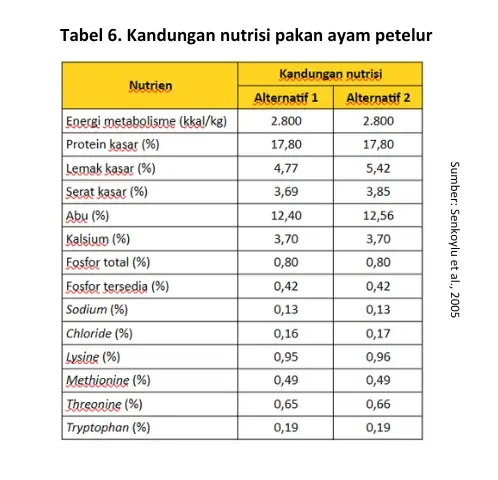
The example formulations above are based on a database of standard quality raw materials. Field formulations may vary depending on the quality and content of available raw materials. Also consider consumption levels, livestock status, and environmental conditions, which can cause differences in nutritional requirements. The nutritional content of laying hen feed is shown in Table 6.
That concludes our brief overview of the latest updates on full-fat soy feed ingredients and their use in chicken feed. We hope this is helpful and broadens your knowledge. Best regards.