Father Rafa
Kudus-Central Java
Is there a way to get rid of acne on the face of a person with acne (pullorum)?
Answer :
Dear. Mr. Rafa, thank you for the question. Coryza (snot) is often also called a runny nose in chickens caused by a bacterial infection Avibacterium paragalinarum (Av. paragalinarum) which include Gram-negative ( - ) bacteria. These bacteria love the location in the sinuses of the nose (sinus infraorbitalis). Clinical symptoms Coryza it can be a melting in the nasal cavity that is initially watery yellow, gradually turning into a thick, purulent with a characteristic odor (foul/fishy odor), and the face area appears swollen. Berak kapurpullorum) or white poop is the name of a disease caused by bacteria Salmonella pullorum (S. Pullorum) which are also Gram-negative ( - ) bacteria.
Disease of Coryza and chalky defecation is equally caused by bacteria, then for its treatment can use antibiotics. Bacteria Av. Paragalinarum and Salmonella pullorum causes Coryza including Gram (-) bacteria so that almost all classes of antibiotics are effective. It's just for infection Av. Paragalinarum in the selection of antibiotics given orally (drinking water or cekok), the group that has better absorption in the gastrointestinal tract is preferred. This is because the bacteria like the location in the sinuses of the nose of which there are few blood vessels.
Effective antibiotics to cope with the disease Coryza and pullorum among others Neo Meditril, Therapy, or Doctril. In the administration of such drugs it is necessary to take into account several things such as dosage, time of administration and duration or duration of administration for the treatment to be effective. Giving a dose that is less will cause the chicken does not recover, as well as if the dose given exceeds the limit can lead to organ damage and even death. The timing of antibiotic administration should be done 2 times a day (dose in 1 day divided by 2 for morning and evening administration), for example at 07.00-13.00 then given again at 13.00-19.00. This aims to maintain antibiotic levels in the body, so that the drug will remain effective and the disease agent can be completely eradicated. The duration of administration must also be in accordance with the rules of the respective antibiotic, for example Neo Meditril administered for 3-5 days. Inappropriate dosing and incomplete treatment can lead to antibiotic resistance antibiotic resistance or a condition in which bacterial resistance increases to the power of certain antibiotics so that bacteria become insensitive or resistant to one type of antibiotic.
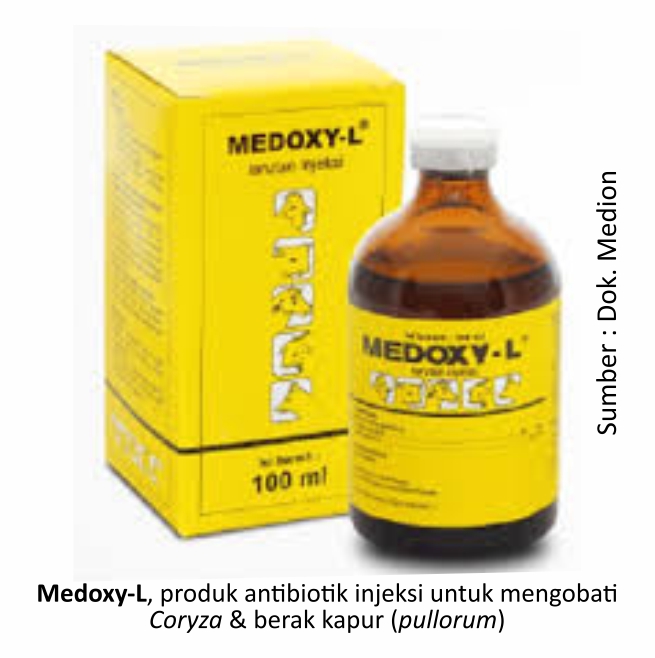
If the condition of the chicken is severe enough and difficult to drink, antibiotics given by injection (injection) can be an option. Especially in chickens affected Coryza and severe facial swelling. Antibiotics that can be given by injection are Neo Meditrile-I, Medoxy-L or Medoxy LA.
In addition to treatment with antibiotics, you can give multivitamins such as Vita Stress or Fortevit to increase the body's resistance and accelerate the restoration of health after illness.
As is known that the favorite place of bacteria Av. paragalinarum is the nasal sinuses. While in the section minimal blood vessels, which causes the drug to reach that location only slightly so Coryza difficult to eradicate completely. Chickens that have been attacked can become carrier or carrier, so that if the chicken's health status decreases, the disease Coryza can re-infect. Be aware of the difficulty of treatment Coryza, then the alternative to control it is prevention with vaccination.
Especially for diseases Coryza preventive measures can be taken through vaccination using Medivac Coryza T, Medivac Coryza T Suspension, atau Medivac Coryza Q Suspension. General guidelines for vaccination programs Coryza on chicken layer that is 6-8 weeks of age and 10 weeks later or 2-3 weeks before production. While the chicken broiler vaccination Coryza not be a mandatory vaccination program, but if the area is prone to Coryza vaccination can be done 1 time in the 1st or 2nd week adjusted to the age of the case. The effect of the vaccine is to promote immunity against Coryza so when the chicken is exposed to Coryza due to the challenges in the farm is high enough to reduce the number of pain (morbidity) and death (mortality). In addition, the healing process in chickens that have been vaccinated becomes easier and faster.