Mr. Haryadi – By email
If broiler chickens are raised in multi-story postal cages and the strong ammonia odor is emitted, respiratory illnesses are often the result. How does ammonia trigger respiratory illness, and can it reduce antibodies? So, how can ammonia levels be reduced?
Answer:
Dear Mr. Haryadi, thank you for your question. Keeping chickens in a multi-level postal cage with a system litter (rice husks) are at higher risk of ammonia exposure. Ammonia is a gas produced by the breakdown of nitrogenous waste in feces by ureolytic bacteria. Ammonia itself exists in two forms in the farmyard: dissolved in fecal fluid (NH₄OH) and gaseous (NH₃).
High ammonia levels can be caused by poor air circulation in the coop, overcrowding of the chicken population, feeding with too high a protein content, or poor management. litter This is not good. If the bottom of the cage is not very high, ammonia levels will increase daily.
Moreover on the farm broiler, salah satu penyusun ransumnya adalah konsentrat, yaitu campuran bahan baku ransum yang mengandung serat kasar <18% dan tinggi protein. Protein itulah yang akan dicerna dan dimetabolisme hingga menghasilkan zat sisa berupa urea dan asam urat yang dibuang bersama dengan feses. Baik urea maupun asam urat, keduanya mengandung unsur nitrogen (N) yang akan diubah menjadi amonia (NH₃ berbentuk gas) atau amonium (NH₄₊ yang terlarut dalam feses) oleh bakteri pengurai (bakteri ureolitik) di lingkungan. Oleh karena itu, sudah hal yang wajar jika dalam pemeliharaan ternak ayam dihasilkan amonia.
Regarding your question, it's true that exposure to ammonia gas can trigger respiratory diseases due to its high irritant effect on chickens. Furthermore, high ammonia levels can indirectly lower antibody levels. All of this is related to the function of the upper respiratory tract, which acts as the primary defense system in the chicken's body. As a result, chickens are susceptible to respiratory diseases, such as CRD and coryza, because the respiratory tract, the body's first line of defense, is damaged.
Ammonia vs Primary Defense System
Chickens naturally have defense mechanisms against various pathogens. One of these is the primary defense system. This defense system includes the skin, cilia (feathers) of the respiratory tract, mucus, enzymes, and even sneezing and coughing. A malfunctioning primary defense system, particularly the respiratory tract, is a major trigger for the entry of pathogens.
At 20 ppm, ammonia can cause ciliostasis (the cessation of ciliary movement) and desiliosis (damage to the cilia), ultimately damaging the respiratory mucosa. As a result, chickens are susceptible to respiratory diseases because the cilia and respiratory mucosa are their first line of defense. In the United States, the maximum ammonia level set by the National Institute of Occupational Safety and Health (NIOSH) in poultry houses is 25 ppm, while the Occupational Safety and Health Administration (OSHA) sets it at 50 ppm. In Indonesia, ammonia level measurements are still rarely carried out by farmers. Nevertheless, farmers should try to keep ammonia levels as low as possible to avoid affecting chicken productivity.
The nasal cavity is equipped with cilia that function as filters for air particles inhaled by chickens, such as dust and germs (viruses and bacteria). Mucus is also produced along the respiratory tract, which functions to eliminate foreign particles and germs that were not previously filtered by the cilia. This mucus contains enzymes, surfactants (reducers of surface tension), and antibodies, such as immunoglobulin (Ig) A, IgG, and IgE. Enzymes and surfactants play a role in destroying germs, while antibodies function to prevent the attachment of germs to the surface of the respiratory tract and neutralize them. Mucosal immunity (IgA), one of which is found in the upper respiratory tract, will experience disruptions in its production due to damage to epithelial cells by ammonia irritation. Meanwhile, high levels of ammonia in the blood (due to inhalation of large amounts) cause stress on lymphocyte cells, so that antibody production (IgG and IgM) is also disrupted (North, 1984).
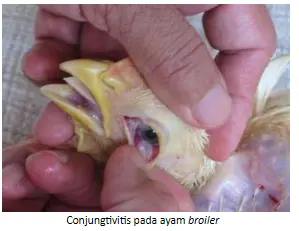
On the other hand, ammonia levels above 20 ppm are also known to irritate the conjunctiva, which can also serve as a gateway for pathogens. Ammonia dissolves in eye fluids and produces NH₄OH, which can irritate and cause conjunctivitis (inflammation of the conjunctiva).
When a disease, such as the ND or AI virus, enters a chicken's body, its antibodies/immunity will decrease. This is especially true if the chicken previously lacked sufficient antibodies (i.e., it had not been vaccinated). red) to fight the disease. Thus, ammonia is a factor that can indirectly reduce antibodies and trigger respiratory illness.
Reducing Ammonia Levels
If the ammonia levels in the coop are very high and the smell is very strong, some measures to reduce the levels include regulating air circulation (opening the coop curtains), adding new rice husks, providing feed with a protein content according to the chickens' needs, and using certain ingredients that can bind ammonia.
Use litter with an initial thickness of around 8-12 cm for postal cages and 5-8 cm for stage cages. Before sowing, litter disinfected first with formalin or FormadesAfter that, it is mixed with lime as much as 1 g/10 m³ litterThis lime functions to help absorb water in litter, and prevent the occurrence of coccidiosis which usually occurs in chickens aged ≥ 3 weeks, because coccidia (the cause of coccidiosis, ed.) cannot withstand the heat from lime.
On time brooding period,, flip it over litter regularly every 3-4 days, starting from 4 to 17 days of age. This is to avoid litter clumped together from the beginning. When there is litter which clumps in small amounts, then litter can be sorted and removed from the cage. However, if the number of litter that clumps or wet already a lot, better stack with litter New. In raised cages or battery cages, scoop out feces once a week or use a litter tray to help the feces dry out quickly and inhibit ammonia production.
One of the products that contains ammonia binder is Ammotrol. Ammotrol safe to use daily for long periods of time to bind ammonia without causing side effects and residue. Awarding Ammotrol also relatively easy, simply sprayed into feces or dissolved in drinking water, and can be given together/mixed with vitamins or antibiotics.
Meanwhile, regarding the treatment of the chicken itself, it needs to be given antibiotics (Neo Meditril or Erydoxcy) in the morning and evening so that any respiratory bacterial diseases that have already attacked, such as CRD and coryza, can be quickly resolved. In the evening, give multivitamins. Kumavit to increase the stamina of the chicken's body. In addition to giving antibiotics, Kobakil can be given as a natural antibacterial that can accelerate the healing of respiratory diseases such as CRD, CRD complex, Coryza, and Colibasillosis. Kobakil works by inhibiting enzyme activity and suppressing bacterial virulence factors, preventing bacterial replication and disrupting cell walls so that intracellular components break down and prevent the formation of energy in the mitochondria so that the bacteria die.
Meanwhile, to treat viral respiratory diseases such as ND, AI, or IB, give multivitamins. Kumavit to increase stamina, as well as to carry out emergency vaccinations (specifically for ND and IB cases), especially if the attack is not yet severe and the chicken is still relatively healthy.